Maths Olympiad Prep

Library / /3 of 18

Geometry Difficulty 7.6 National olympiad, round 2 Prove it Balkan Mathematical Olympiad

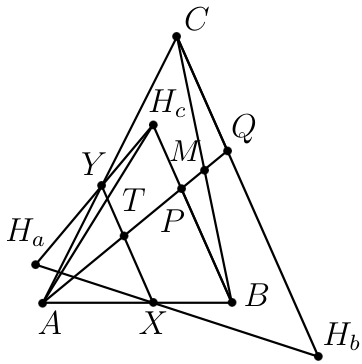
Let II be the incenter of ABC\triangle ABC and let HaH_a, HbH_b, and HcH_c be the orthocenters of BIC\triangle BIC, CIA\triangle CIA, and AIB\triangle AIB, respectively. The line HaHbH_aH_b meets ABAB at XX and the line HaHcH_aH_c meets ACAC at YY. If the midpoint TT of the median AMAM of ABC\triangle ABC lies on XYXY, prove that the line HaTH_aT is perpendicular to BCBC.

Solution

Let the lines through BB and CC parallel to XYXY meet AMAM at PP and QQ, respectively. Since BM=MCBM = MC, we have PM=MQPM = MQ and
BXXA+CYYA=PTTA+QTTA=PT+QTTA=2MTTA=2. \frac{BX}{XA} + \frac{CY}{YA} = \frac{PT}{TA} + \frac{QT}{TA} = \frac{PT + QT}{TA} = \frac{2MT}{TA} = 2.
Figure 1
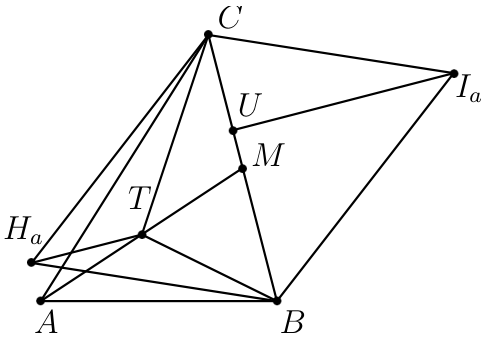
Let IaI_a, IbI_b, and IcI_c be the excenters of ABC\triangle ABC opposite AA, BB, and CC, respectively. Since the figures BHaCIaBH_aCI_a, CHbAIbCH_bAI_b, and AHcBIcAH_cBI_c are parallelograms, we have
2=BXXA+CYYA=BHaHbA+CHaHcA=IaCCIb+IaBBIc=rarb+rarc=S/(pa)S/(pb)+S/(pa)S/(pc)=pbpa+pcpa, \begin{aligned} 2 &= \frac{BX}{XA} + \frac{CY}{YA} = \frac{BH_a}{H_bA} + \frac{CH_a}{H_cA} = \frac{I_aC}{CI_b} + \frac{I_aB}{BI_c} \\ &= \frac{r_a}{r_b} + \frac{r_a}{r_c} = \frac{S/(p-a)}{S/(p-b)} + \frac{S/(p-a)}{S/(p-c)} = \frac{p-b}{p-a} + \frac{p-c}{p-a}, \end{aligned}
which is equivalent to 2a=b+c2a = b + c.

On the other hand, HaTBCBHa2HaC2=BT2TC2H_aT \perp BC \Leftrightarrow BH_a^2 - H_aC^2 = BT^2 - TC^2. Let UU be the tangency point of the ex-circle opposite AA and BCBC. Then
BHa2HaC2=CIa2IaB2=CUa2UB2=(pb)2(pc)2=a(cb). BH_a^2 - H_aC^2 = CI_a^2 - I_aB^2 = CU_a^2 - UB^2 = (p-b)^2 - (p-c)^2 = a(c-b).
Figure 2
Also, since BTBT and CTCT are medians in ABM\triangle ABM and ACM\triangle ACM, respectively, we have
BT2TC2=12(BA2+BM2)14AM212(CA2+CM2)+14AM2=12(BA2CA2)=12(cb)(c+b). \begin{aligned} BT^2 - TC^2 &= \frac{1}{2}(BA^2 + BM^2) - \frac{1}{4}AM^2 - \frac{1}{2}(CA^2 + CM^2) + \frac{1}{4}AM^2 \\ &= \frac{1}{2}(BA^2 - CA^2) = \frac{1}{2}(c-b)(c+b). \end{aligned}
If b=cb = c, then HaTBCH_aT \perp BC by symmetry. If bcb \neq c, then the above implies that
HaTBCBHa2HaC2=BT2TC2a=12(b+c), H_aT \perp BC \Leftrightarrow BH_a^2 - H_aC^2 = BT^2 - TC^2 \Leftrightarrow a = \frac{1}{2}(b+c),
as needed.

Want a route through all this instead of an archive? The track puts 2,000 problems in a working order, from AMC 10 level to the IMO shortlist.

Source: MathNet, licensed CC-BY-4.0. Statement and solution reproduced as published; topic and difficulty added by this site.