A holey triangle is an upward equilateral triangle of side length with upward unit triangular holes cut out. A diamond is a - unit rhombus. Prove that a holey triangle can be tiled with diamonds if and only if the following condition holds: Every upward equilateral triangle of side length in contains at most holes, for .
(Colombia)
IMO Shortlist, 2006
Solution
Let be a holey triangle. The unit triangles in it will be called cells. We say simply "triangle" instead of "upward equilateral triangle" and "size" instead of "side length."
The necessity will be proven first. Assume that a holey triangle can be tiled with diamonds and consider such a tiling. Let be a triangle of size in containing holes. Focus on the diamonds which cover (one or two) cells in . Let them form a figure . The boundary of consists of upward cells, so is a triangle of size with upward holes cut out and possibly some downward cells sticking out. Hence there are exactly upward cells in , and at least downward cells (not counting those sticking out). On the other hand each diamond covers one upward and one downward cell, which implies . It follows that , as needed.
We pass on to the sufficiency. For brevity, let us say that a set of holes in a given triangle is spread out if every triangle of size in contains at most holes. For any set of spread out holes, a triangle of size will be called full of if it contains exactly holes of . The proof is based on the following observation.
Lemma. Let be a set of spread out holes in . Suppose that two triangles and are full of , and that they touch or intersect. Let denote the smallest triangle in containing them. Then is also full of .
Proof. Let triangles and have sizes and , and let them contain and holes of , respectively. (Note that could be a point, in which case .) Since is spread out, we have and . The geometric configuration of triangles clearly satisfies . Furthermore, , since counts twice the holes in . These conclusions imply and , as we wished to show.
Now let be a holey triangle of size , and let the set of its holes be spread out. We show by induction on that can be tiled with diamonds. The base is trivial. Suppose that and that the claim holds for holey triangles of size less than .
Denote by the bottom row of and by the triangle formed by its top rows. There is at least one hole in as contains at most holes. If this hole is only one, there is a unique way to tile with diamonds. Also, contains exactly holes, making it a holey triangle of size , and these holes are spread out. Hence it remains to apply the induction hypothesis.
So suppose that there are holes in and label them from left to right. Let be the line separating from . For each , pick an upward cell between and , with base on . Place a diamond to cover and its lower neighbour, a downward cell in . The remaining part of can be tiled uniquely with diamonds. Remove from row and the cells to obtain a holey triangle of size . The conclusion will follow by induction if the choice of guarantees that the following condition is satisfied: If the holes are replaced by then the new set of holes is spread out again.
We show that such a choice is possible. The cells can be defined one at a time in this order, making sure that the above condition holds at each step. Thus it suffices to prove that there is an appropriate choice for , and we set for clarity.
Let be the triangle of maximum size which is full of , contains the top vertex of the hole , and has base on line . Call the associate of . Observe that does not touch . Indeed, if has size then it contains holes of . Extending its slanted sides downwards produces a triangle of size containing at least one more hole, namely . Since there are at most holes in , it cannot contain . Consequently, does not contain the top vertex of .
Let be the upward cell with base on which is to the right of and shares a common vertex with it. The observation above shows that is to the left of . Note that is not a hole, or else could be extended to a larger triangle full of .
We prove that if the hole is replaced by then the new set of holes is spread out again. To verify this, we only need to check that if a triangle in contains but not then is not full of . Suppose to the contrary that is full of . Consider the minimum triangle containing and the associate of . Clearly is larger than , because contains but does not. Next, is full of by the lemma, since and have a common point and neither of them contains .
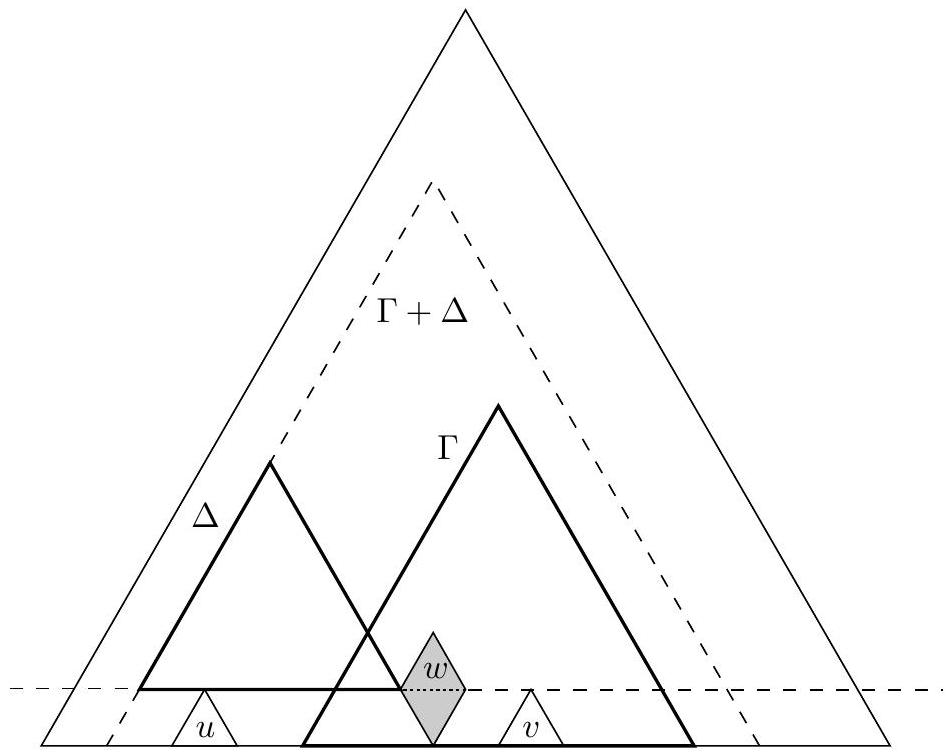
If is above line then so is , which contradicts the maximum choice of . If contains cells from row , observe that contains . Let be the size of . Being full of contains holes other than . But it also contains , contradicting the assumption that is spread out.
The claim follows, showing that is an appropriate choice for and . As explained above, this is enough to complete the induction.
Want a route through all this instead of an archive? The track
puts 2,604 problems in a working order, from Junior Challenge level to the IMO shortlist.