Let be a cyclic quadrilateral and its circumcircle. Let , , and be the incenters of the triangles , , and , respectively. Also, let be the midpoint of the arc of containing . The line intersects at (). Prove that the points , , , and lie on the same circle.
Czech-Polish-Slovak Mathematics Competition
Solution
Let and be the midpoints of the arcs and (not containing any other vertices of ), respectively. Then the incenter lies on , the incenter lies on , and the incenter lies on . Moreover, we have
(these well-known relations follow from an easy angle chasing).
Observe also that the incenter necessarily lies in the interior of the isosceles triangle , hence the line intersects the segment and the point lies on the same side of as (Fig. 2).
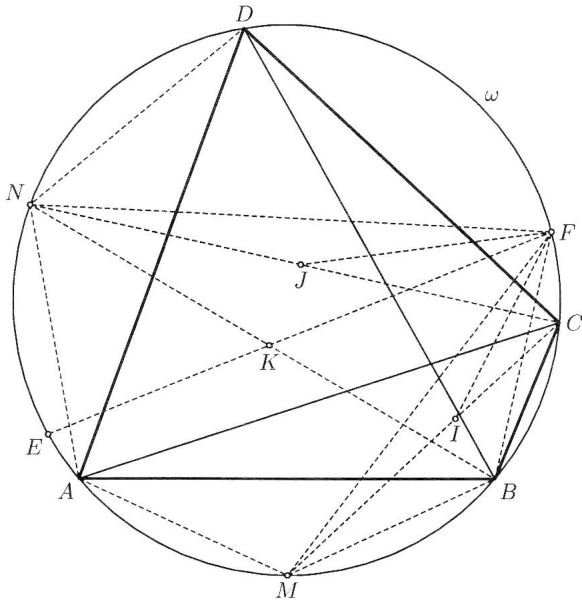
Fig. 2
Consider now the arc of containing . The point is the midpoint of this arc, and the points and are the midpoints of the subarcs and , respectively. It follows that the subarcs and are of equal length (and similarly the subarcs and are of equal length). Thus
But clearly we have
The equalities (2) and (3) imply that the triangles and are similar, and with the same orientation. Therefore
which by an application of (1) can be rewritten as
This, together with the relation
proves that the triangles and are similar with the same orientation. This orientation-preserving similarity implies that
Hence
and the points , , , are indeed concyclic.
Want a route through all this instead of an archive? The track
puts 2,604 problems in a working order, from Junior Challenge level to the IMO shortlist.