Maths Olympiad Prep

Library / /44 of 53

Geometry Difficulty 7.2 National olympiad, round 2 Prove it Vietnam

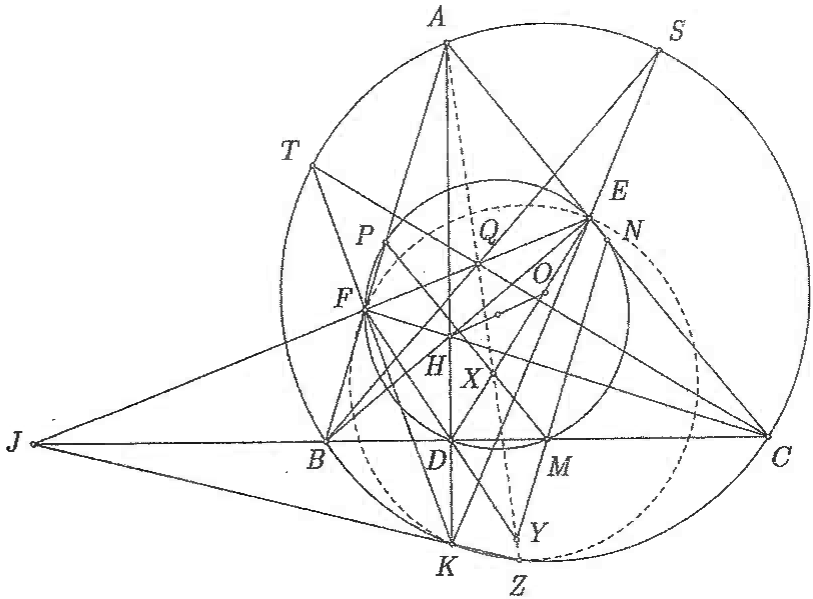
Given an acute, scalene triangle ABCABC with circumcircle (O)(O) and orthocenter HH. Let MM, NN and PP be the midpoints of BCBC, CACA and ABAB and DD, EE and FF be the feet of the altitudes from AA, BB and CC of triangle ABCABC. Let KK be the reflection of HH through BCBC. Two lines DEDE, MPMP intersect at XX and two lines DFDF, MNMN intersect at YY.

a) Line XYXY intersects the minor arc BCBC of (O)(O) at ZZ. Prove that KK, ZZ, EE and FF are concyclic.

b) Lines KEKE, KFKF meet (O)(O) at SS, TT. Prove that BSBS, CTCT and XYXY are concurrent.

Solution

a) First, applying Pascal's theorem for 6 points (DPNDPN, MEFMEF), we get the intersections of pairs of lines (DE,MPDE, MP); (DF,MNDF, MN); (PF,NEPF, NE) collinear or AA, XX and YY are collinear.

Figure 1

Clearly, 180BAC=BHC=BKC180^\circ - \angle BAC = \angle BHC = \angle BKC so KK lies on (O)(O). Next, we will prove that XYXY bisects EFEF.

Note that MNMN, MPMP are the midlines of the triangle ABCABC so MNABMN \parallel AB, MPACMP \parallel AC. Therefore, by Thales's theorem, we have
YDYF=MDMB,XE=MCMD \frac{YD}{YF} = \frac{MD}{MB}, \quad XE = \frac{MC}{MD}
Let QQ be the intersection of XYXY and EFEF. Applying Menelaus' theorem to triangle DEFDEF, we get
QFQE=XDXE,YFYD=MBMD,MDMC=1 \frac{QF}{QE} = \frac{XD}{XE}, \quad \frac{YF}{YD} = \frac{MB}{MD}, \quad \frac{MD}{MC} = -1
or QQ is the midpoint of EFEF. It follows that AQAQ, AMAM are isogonal with respect to angle BAC\angle BAC, so AQAQ is the symmedian of triangle ABCABC. Therefore, ABZCABZC is a harmonic quadrilateral.

Let JJ be the intersection of EFEF and BCBC, then (JD,BC)=1(JD, BC) = -1 so K(JD,BC)=1K(JD, BC) = -1 but we also have K(ZA,BC)=1K(ZA, BC) = -1, which implies KZKZ passes through JJ.

Finally, we have JEJF=JBJC=JKJZJE \cdot JF = JB \cdot JC = JK \cdot JZ so K,Z,EK, Z, E and FF are concyclic.

b) We have EBF=ECH=EDH\angle EBF = \angle ECH = \angle EDH, HED=HCD=BEF\angle HED = \angle HCD = \angle BEF because BCEFBCEF, EHDCEHDC are cyclic quadrilaterals. Therefore, BEFDEH\triangle BEF \sim \triangle DEH (a.a). Hence,
HK2EH=HDEH=BFEF=BF2FQ \frac{HK}{2EH} = \frac{HD}{EH} = \frac{BF}{EF} = \frac{BF}{2FQ'}
but we also have BFQ=EHK\angle BFQ = \angle EHK, then BFQSLE\triangle BFQ \sim \triangle SLE (s.a.s), which implies
FBQ=EKH=ABS \angle FBQ = \angle EKH = \angle ABS
or BB, QQ and SS are collinear. Similarly, CC, TT and SS are collinear. Therefore, BSBS, CTCT and XYXY are concurrent at QQ. \square

Want a route through all this instead of an archive? The track puts 2,000 problems in a working order, from AMC 10 level to the IMO shortlist.

Source: MathNet, licensed CC-BY-4.0. Statement and solution reproduced as published; topic and difficulty added by this site.