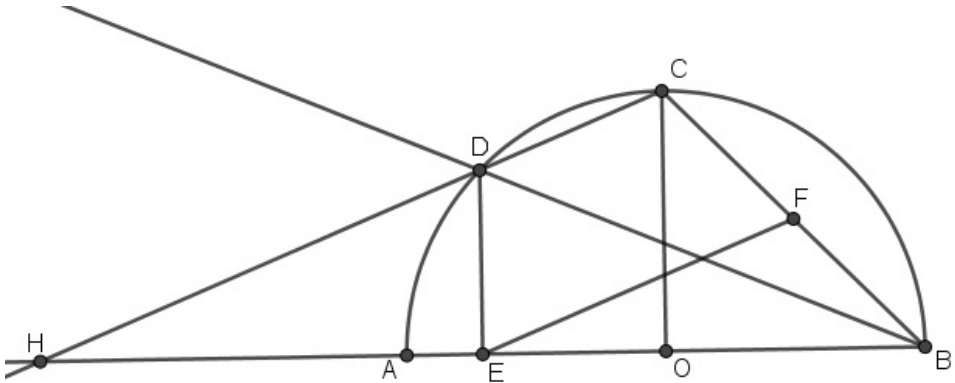
Note that the triangle ABC is isosceles right triangle. Let CD∩AB={H}. From
∠AED=∠ADB=90∘ and ∠DAE=∠DAB
follows that △ADE∼△ABD. Since ABCD is cyclic, it follows
∠ADC=180∘−∠ABC=135∘ i.e. ∠HDA=45∘. Hence,
∠DAB=∠DAC+∠CAB=∠DBC+∠CAB=22∘30′+45∘=67∘30′
Now we have,
∠HAD=180∘−∠DAB=180∘−67∘30′=112∘30′
and
∠AHD=180∘−(∠HAD+∠HDA)=180∘−157∘30′=22∘30′
i.e. △HDB is isosceles. Since △HDB is isosceles and DE⊥AB it follows that E is a midpoint of HB. Since E is a midpoint of HB and F is a midpoint of CB, follows that EF is a median line in △HBC i.e. EF∥HC i.e. EF∥CD. Hence, the quadrilateral
EFCD is trapezoid. Furthermore, EF∥HC, so we have ∠FEB=∠CHB=22∘30′. From DE⊥AB we have
∠DEF=90∘−∠FEB=90∘−22∘30′=67∘30′
Then,
∠EFB=180∘−(∠FEB+∠EBF)=180∘−67∘30′=112∘30′ i.e.
∠CFE=180∘−∠EFB=67∘30′
Finally, EFCD is an isosceles trapezoid, hence the statement in the problem follows.