Let be a triangle with incentre , and let be the circumcircle of triangle . Let be a point in the interior of segment such that . The angle bisector of intersects at points and such that and lie on the same side of , and the angle bisector of intersects at points and such that and lie on the same side of .
Prove that .
IMO Shortlist
Solution
Solution 1. Let be circle and be circle . Let , and be the centres of , and , respectively. Let intersect again at , and let the angle bisector of intersect again at .
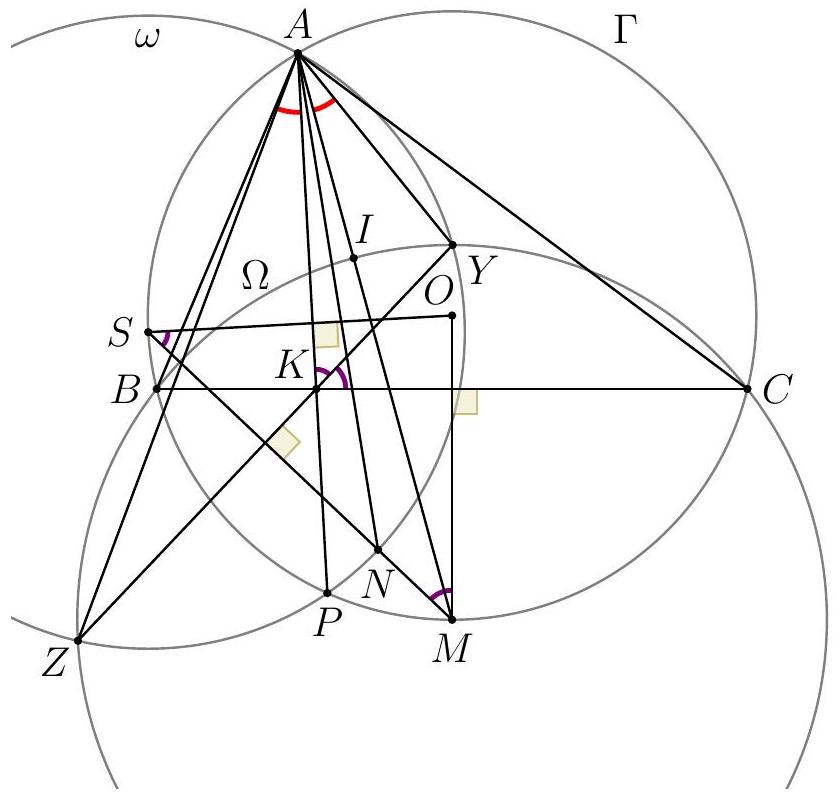
By power of a point from to and , we have that , so also lies on . The pairwise common chords of , and are then , and , so we have that . As lies on and , also lies on . Note that lies on as , so
Thus, bisects in addition to , which means that as lies on and lies on .
Solution 2. Define and as in Solution 1, and recall that is cyclic. Let be the second intersection of the line parallel to through with circle and let be the incentre of triangle .
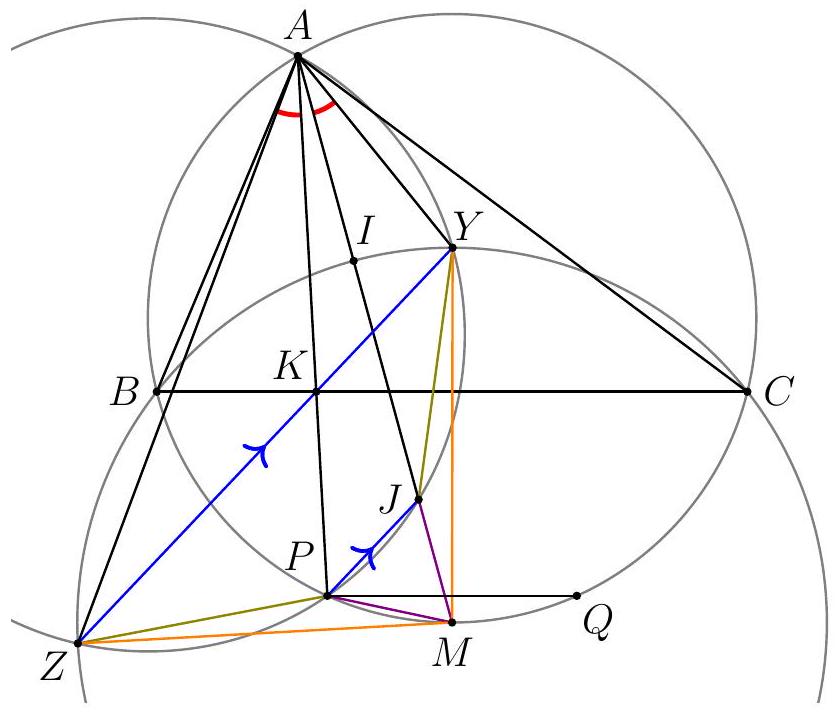
Since is parallel to and , the angle bisector of is parallel to the angle bisector of . Hence, is parallel to . As is the midpoint of on circle , we have that . Then since segments and are parallel and have a common point on their perpendicular bisectors, is cyclic with . It follows that also lies on circle and that .
Solution 3. As in the previous solutions, let be the centre of . Let be the intersection of and , and let be the reflection of over . Let the circle intersect again at .
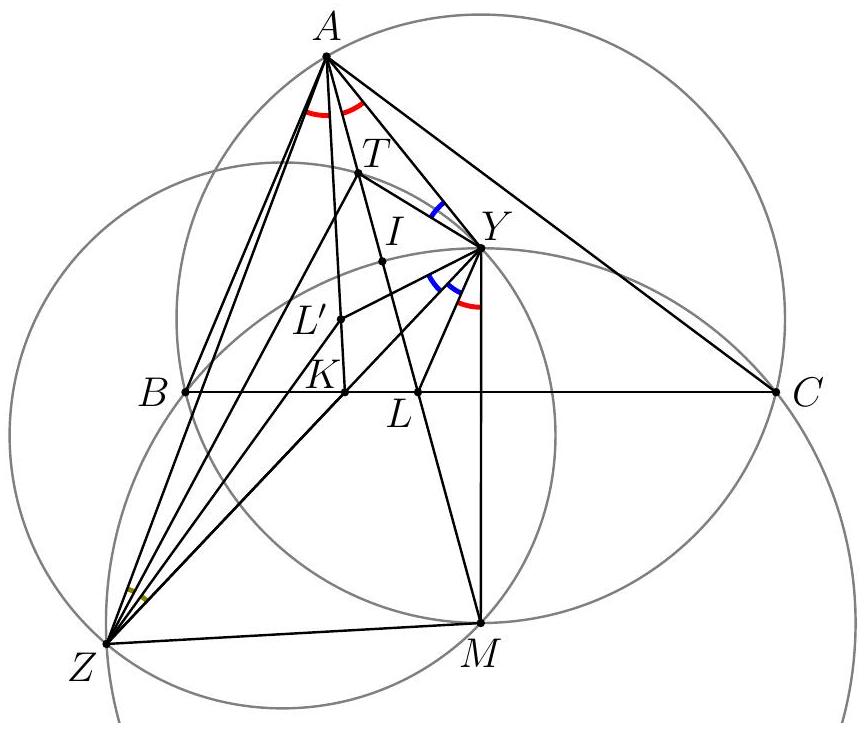
Note that as is the midpoint of on circle and is the foot of the bisector of , we have that . It follows by power of a point that is tangent to circle , so . Using directed angles, we then have that
where we use the fact that and that and are symmetric about . Thus, and are isogonal in . Analogously, we have that and are isogonal in . This means that and are isogonal conjugates in triangle , which allows us to conclude that since lies on and lies on .
Want a route through all this instead of an archive? The track
puts 2,604 problems in a working order, from Junior Challenge level to the IMO shortlist.