Throughout the solution, we shall denote by SXYZ the area of the triangle XYZ.
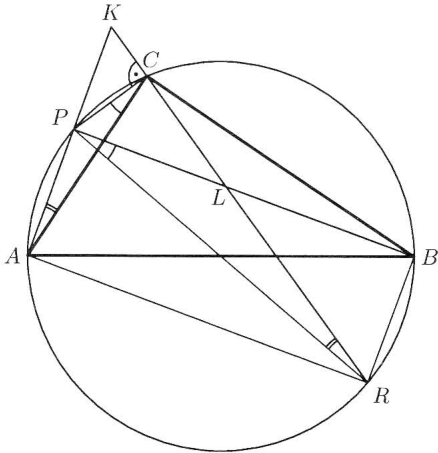
Fig. 3
Let PR be the diameter of the circumcircle of ABC (Fig. 3). Then ARBP is a rectangle. Since BR is parallel to PA we have SPBK=SPRK, which implies
SBKL=SLPR.
Since PA=BR we have ∠PCA=∠BPR=∠LPR.
Also, because CPAR is cyclic we have ∠CAP=∠CRP. Hence LPR and PCA are similar triangles.
Finally, we have
SBKL:SACP=SLPR:SACP=PR2:AC2=AB2:AC2
which does not depend on the point P.
Second solution.
Denote the lengths of the sides and the sizes of the angles of the triangle ABC by a, b, c and α, β, γ, respectively (Fig. 4). Let ∠PAC=φ. Simple angle chasing gives ∠CPB=α, ∠PBC=φ, ∠LCB=∠ACP=∠ABP=β−φ, ∠BLC=∠APC=90∘+α, ∠PKL=α. Also, AP=ccos(α+φ), BP=csin(α+φ).
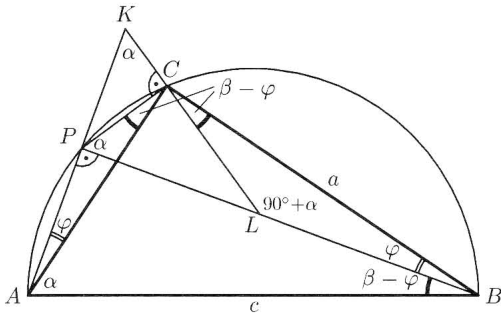
Fig. 4
Using the sine law in BCP and BCL we get
CP=sinαBCsinφ=sinαasinφ,
BL=sin(90∘+α)BCsin(β−φ)=cosαacos(α+φ).
Then
PL=BP−BL=csin(α+φ)−cosαacos(α+φ)==cosαcsin(α+φ)cosα−csinαcos(α+φ)=cosαcsinφ.
KL=sinαPL=sinαcosαcsinφ.
SAPCSKLB=21AP⋅CP⋅sin(90∘+α)21BL⋅KL⋅sin(90∘+α)=AP⋅CPBL⋅KL=ccos(α+φ)⋅sinαasinφcosαacos(α+φ)⋅sinαcosαcsinφ=cos2α1,
and α is clearly independent on the choice of the point P.
Remark. We can shorten the previous solution by noticing that from the angles we have a pair of similar triangles BLC, APC (Fig. 4). Then BL/AP=LC/PC and the desired ratio can be expressed as
S KLB S APC = BL KL}{AP ⋅ CP} = LC KL}{PC^2}.