Maths Olympiad Prep

Library / /24 of 53

Geometry Difficulty 6.5 National olympiad Prove it Vietnam

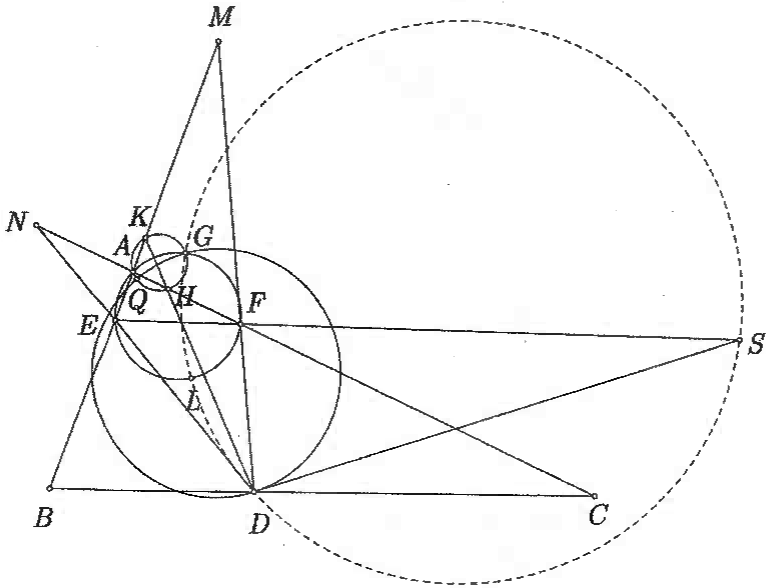
Given an acute, scalene triangle ABCABC, DD is a point on side BCBC. Let EE, FF be the points on ABAB, ACAC such that DEB=DFC\angle DEB = \angle DFC. Lines DFDF, DEDE intersect ABAB, ACAC at points MM, NN, respectively. Denote (I1)(I_1), (I2)(I_2) by the circumcircles of triangles DEMDEM, DFNDFN. The circle (J1)(J_1) touches (I1)(I_1) internally at DD and touches ABAB at KK, circle (J2)(J_2) touches (I2)(I_2) internally at DD and touches ACAC at HH. Let PP be the intersection of (I1)(I_1), (I2)(I_2) and QQ be the intersection of (J1)(J_1), (J2)(J_2) (P,QDP, Q \neq D).

a) Prove that DD, PP, and QQ are collinear.

b) The circumcircle of triangle AEFAEF meets the circumcircle of triangle AHKAHK again at GG and meets the line AQAQ again at LL. Prove that the tangent line from DD of the circumcircle of triangle DQGDQG intersects EFEF at a point on the circumcircle of triangle DLGDLG.

Solution

a. Note that DEB=DFC\angle DEB = \angle DFC then DEA=DFA\angle DEA = \angle DFA, which implies MNEFMNEF is a cyclic quadrilateral.

We have DI2F=2DNF=2EMF\angle DI_2F = 2\angle DNF = 2\angle EMF and
I2DF=9012DI2F \angle I_2DF = 90^\circ - \frac{1}{2} \angle DI_2F
so I2DMEI_2D \perp ME. We also have J1KMEJ_1K \perp ME and it follows that I2DJ1KI_2D \parallel J_1K. Similarly, we get I1DJ2HI_1D \parallel J_2H. Hence, I2DK=DKJ1=KDJ1\angle I_2DK = \angle DKJ_1 = \angle KDJ_1 or DKDK is the bisector of I2DI1\angle I_2DI_1. Similarly, we also have DHDH is the bisector of I2DI1\angle I_2DI_1. Hence, three points DD, HH and KK are collinear.

Since MNEFMNEF is cyclic, AEAM=AFANAE \cdot AM = AF \cdot AN, so AA belongs to the radical axis of (I1)(I_1) and (I2)(I_2) which implies AA, DD and PP are collinear. Furthermore,
AKH=90DKJ1=90DHJ2=DHF=AHK \angle AKH = 90^\circ - \angle DKJ_1 = 90^\circ - \angle DHJ_2 = \angle DHF = \angle AHK
so AH=AKAH = AK. It follows that AA has the same power to (J1)(J_1) and (J2)(J_2), or AA lies on the radical axis of (J1)(J_1) and (J2)(J_2). Hence, AA, DD and QQ are collinear.

From these, we have four points AA, DD, PP, QQ are collinear.

b. Since AKAK is a tangent of (J1)(J_1) then AQK=AKD=AHK\angle AQK = \angle AKD = \angle AHK, it follows that AQHKAQHK is cyclic. We have GEF=GAF=GKH\angle GEF = \angle GAF = \angle GKH, GHK=GAK=GFE\angle GHK = \angle GAK = \angle GFE so GEFGKH\triangle GEF \sim \triangle GKH (a.a).

Figure 1

Take the point SS in EFEF such that SE:DF=DK:DH\overline{SE} : \overline{DF} = \overline{DK} : \overline{DH}, then GESGKD\triangle GES \sim \triangle GKD (s.a.s). Thus, GEKGSD\triangle GEK \sim \triangle GSD (s.a.s). From here, we have
GDS=GKE=GQD \angle GDS = \angle GKE = \angle GQD
so DSDS is the tangent of the circumcircle of triangle GDQGDQ. Similarly, LEFQKH\triangle LEF \sim \triangle QKH (a.a) so LESQKD\triangle LES \sim \triangle QKD (s.a.s). Hence, KQD=ELS\angle KQD = \angle ELS, and
KQG=KHG=EFG=ELG \angle KQG = \angle KHG = \angle EFG = \angle ELG
which implies SLG=DQG=GDS\angle SLG = \angle DQG = \angle GDS. It shows that DLGSDLGS is a cyclic quadrilateral. From these results, the problem is proved. \square

Want a route through all this instead of an archive? The track puts 2,000 problems in a working order, from AMC 10 level to the IMO shortlist.

Source: MathNet, licensed CC-BY-4.0. Statement and solution reproduced as published; topic and difficulty added by this site.