Two circles lie completely outside each other. Let be the point of intersection of internal common tangents of the circles and let be the projection of this point onto their external common tangent. The tangents, different from the common tangent, to the circles through point meet the circles at and . Prove that the line bisects the angle .
IMO Team Selection Contest
Solutions — 2
Solution 1
Let and be the points of tangency of the external common tangent of the circles, and be the points of tangency of an internal common tangent, and and be the centers of the two circles (see Fig. 18).
As all the lines , , and are perpendicular to the line , they are parallel to each other and thus The triangles and are similar because they are both right-angled and have the same vertical angles. Thus, Therefore, the right-angled triangles and are similar due to proportionality of their legs. Hence, .
As and , we also get that . Together with the equality this implies .
Solution 2
Both of the circles appear at the same angle, when viewed from the point . To solve the problem, it is enough to show that both of the circles also appear at the same angle, when viewed from the point .
Let the centers of the circles have the coordinates and and let and be the radii of the circles. The two circles appear at the same angle from the point if and only if i.e., Simple algebra shows that this equation is equivalent to where , and are some constants.
If , then the statement clearly holds. If , then the last equation is that of a circle. Point as well as the point of intersection of the external common tangents both lie on that circle, and from symmetry, the diameter of that circle is . As is perpendicular to the external common tangent of the circles, the point also lies on that circle.
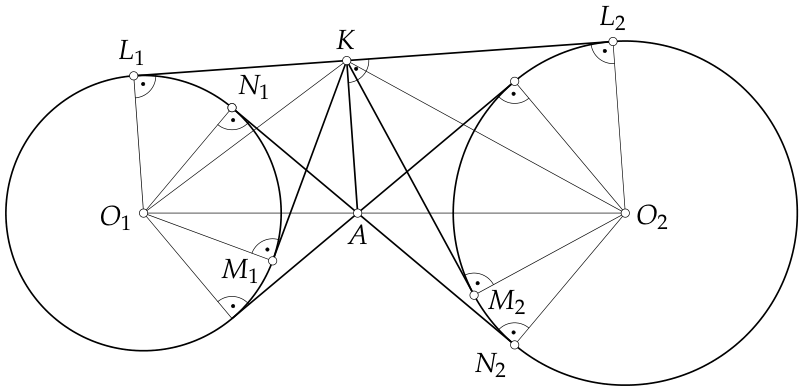
Fig. 18
Want a route through all this instead of an archive? The track
puts 2,604 problems in a working order, from Junior Challenge level to the IMO shortlist.