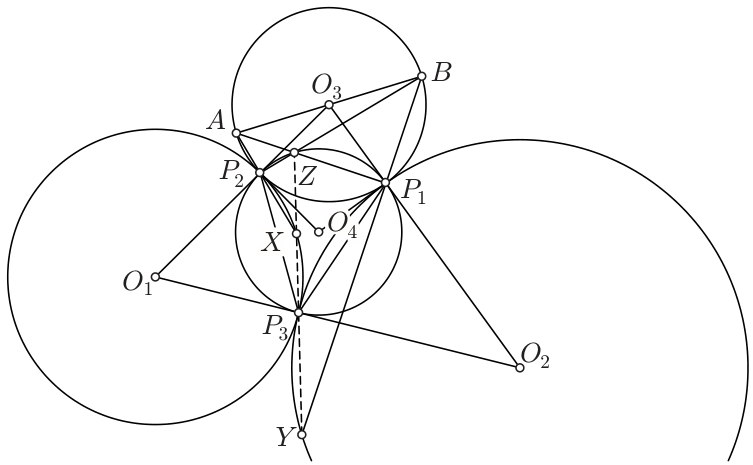
The circles Γ1, Γ2, and Γ3 in the plane are pairwise externally tangent. Let P2 be the point of tangency between the circles Γ1 and Γ3, and P1 the point of tangency between the circles Γ2 and Γ3. Consider points A and B on the circle Γ3 that are diametrically opposite, such that the quadrilateral ABP1P2 is convex. The line through A and P2 intersects the circle Γ1 a second time at point X, the line through B and P1 intersects the circle Γ2 a second time at point Y, and the lines AP1 and BP2 intersect at Z. Prove that the points X,Y, and Z are collinear.
Solution
Let {P3}=Γ1∩Γ2 be the second point of intersection of the circles Γ1 and Γ2, and let O1,O2,O3 be the centers of the circles Γ1,Γ2, and Γ3, respectively. Denote by O4 the intersection point of the common tangents to the circles Γ1 and Γ2.
P1ZP2=21(AB+P1P2)=21(180∘+P1O3P2)=21(180∘+180∘−P1O2P3−P2O1P3)==21(180∘−P1O2P3)+21(180∘−P2O1P3)=O1P3P2+O2P3P1=180∘−P1P3P2, so the quadrilateral ZP1P3P2 is cyclic.
We will prove that X,P3, and Z are collinear. It suffices to show that XP3O1=ZP3O2. Since triangle O1XP3 is isosceles and BP2⊥AX (because AB is a diameter), we have: XP3O1=21(180∘−XO1P3)=90∘−21XP3=XP2B−XP2P3=BP2P3=ZP2P3=21ZP1P3. Because O1O2 is tangent to the circumcircle of triangle P1P2P3, it follows that P1P3O2=21P1P3. Therefore, ZP3O2=ZP3P1+P1P3O2=21ZP1+21P1P3=21ZP1P3=XP3O1. Hence, points X,Z, and P3 are collinear. Similarly, one can show that Y,Z, and P3 are collinear, and thus X,Y, and Z are collinear as well.
Want a route through all this instead of an archive? The track
puts 2,604 problems in a working order, from Junior Challenge level to the IMO shortlist.
Source: MathNet,
licensed CC-BY-4.0.
Statement reproduced verbatim; metadata (topic, difficulty) added by this project.