△ABC is a triangle and Ib,Ic its excenters opposite to B,C. Prove that △ABC is right at A if and only if its area is equal to 21AIb⋅AIc.
Solution
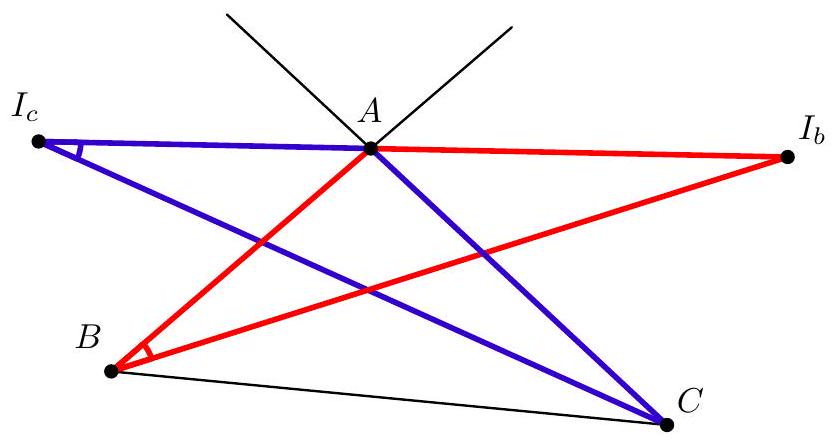
First solution. Let △ABC be any triangle. Considering triangle AIcC, we have ∡CIcA=180∘−(∡ACIc+∡IcAC)=180∘−(21∡ACB+∡BAC+21(180∘−∡BAC))=90∘−21(∡ACB+∡BAC)=∡IbBA.
On the other hand, ∡IcAC=∡BAIb. We deduce that triangles ABIb,AIcC are similar and therefore ABAIc=AIbAC⇔AIb⋅AIc=AB⋅AC. Thus, the area of triangle ABC is equal to 21AIb⋅AIcsin∡BAC. Hence, triangle △ABC is right at A if and only if its area is equal to 21AIb⋅AIc.
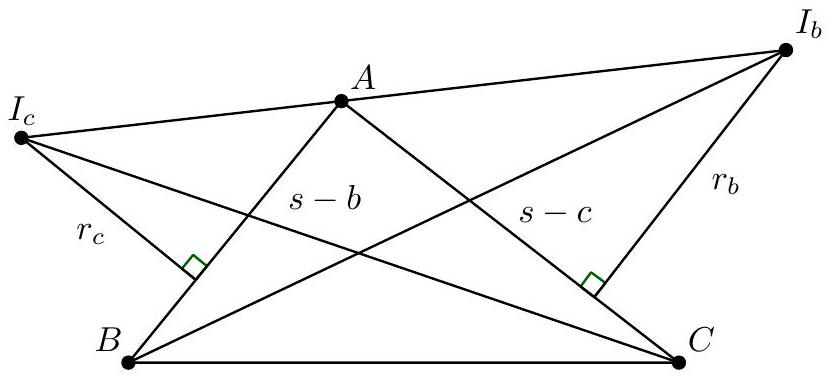
Second solution. Let △ABC be any triangle. Denote a,b,c the lengths of the opposite sides to the vertices A,B,C respectively, s the semiperimeter, r the inradius, rb,rc the exradius opposite to the vertices B,C respectively. We have AIb2=rb2+(s−c)2 and AIc2=rc2+(s−b)2.
But the area of the triangle △ABC is equal to K=rs=rb(s−b)=rc(s−c)=s(s−a)(s−b)(s−c), and that rbrc=s(s−a) (which follows from the above formulas for the area). Hence AIb2⋅AIc2=(rb2+(s−c)2)(rc2+(s−b)2)=s2(s−a)2+2K2+(s−b)2(s−c)2. Therefore, K=21AIb⋅AIc is equivalent to 2K2=s2(s−a)2+(s−b)2(s−c)2. But 2K2=2s(s−a)(s−b)(s−c). Hence, this is equivalent to ((s−b)(s−c)−s(s−a))2=0 which simplifies to a2=b2+c2.
Want a route through all this instead of an archive? The track
puts 2,604 problems in a working order, from Junior Challenge level to the IMO shortlist.
Source: MathNet,
licensed CC-BY-4.0.
Statement reproduced verbatim; metadata (topic, difficulty) added by this project.