Maths Olympiad Prep

Library / /113 of 155

Geometry Difficulty 6.6 National olympiad Prove it Saudi Arabia

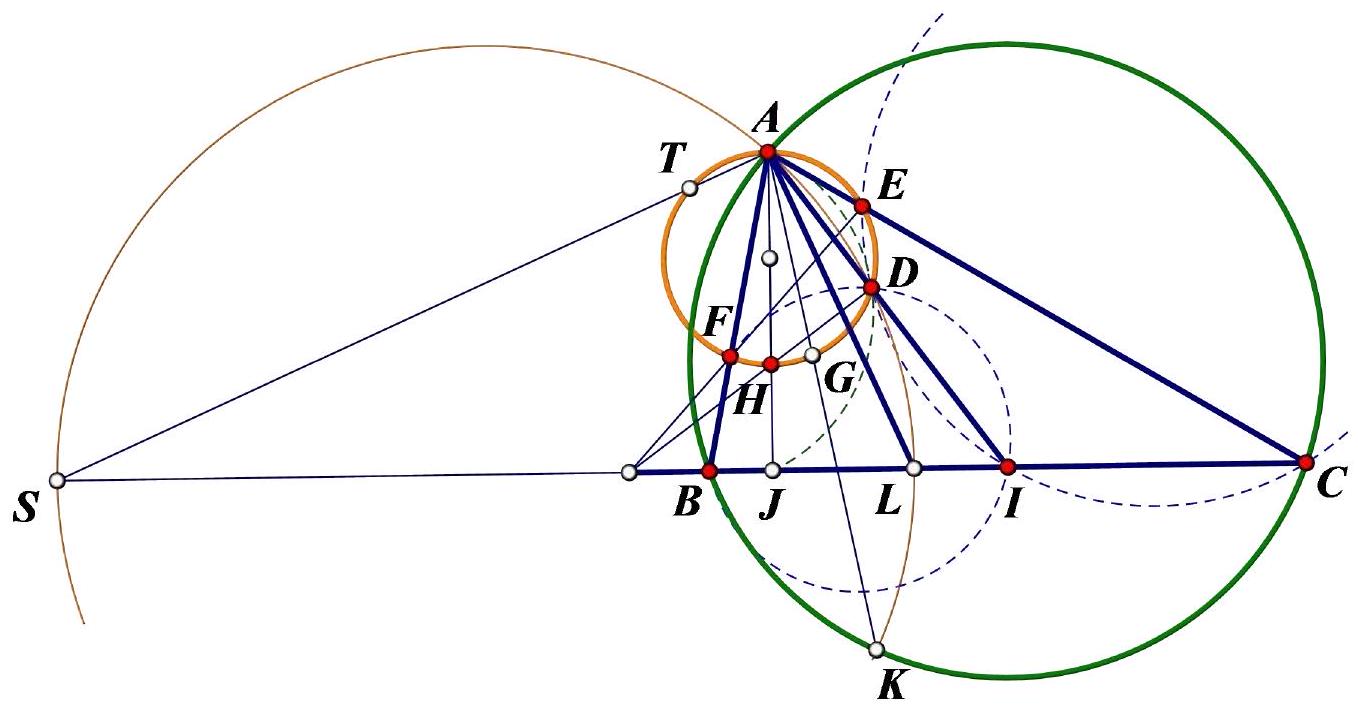
Let ABCABC be an acute triangle and (O)(O) be its circumcircle. Denote by HH its orthocenter and II the midpoint of BCBC. The lines BHBH, CHCH intersect ACAC, ABAB at EE, FF respectively. The circles (IBF)(IBF) and (ICE)(ICE) meet again at DD.

1. Prove that DD, II, AA are collinear and HDHD, EFEF, BCBC are concurrent.

2. Let LL be the foot of the angle bisector of BAC\angle BAC on the side BCBC. The circle (ADL)(ADL) intersects (O)(O) again at KK and intersects the line BCBC at SS out of the side BCBC. Suppose that AKAK, ASAS intersect the circle (AEF)(AEF) again at GG, TT respectively. Prove that TG=TDTG = TD.

Solution

1) From the power of point to circle, we have
PA/(BIF)=AFAB and PA/(CIE)=AEAC. \mathscr{P}_{A /(BIF)} = AF \cdot AB \text{ and } \mathscr{P}_{A /(CIE)} = AE \cdot AC.
But it is easy to see that AFAB=AEACAF \cdot AB = AE \cdot AC then AA belongs to the radical axis of two circles (BIF)(BIF), (CIE)(CIE).
Hence, AA, DD, II are collinear.
Denote J=AHBCJ = AH \cap BC then ADAI=AHAJAD \cdot AI = AH \cdot AJ which implies that HH, DD, II, JJ are concyclic, then HDAIHD \perp AI. Then by considering the radical axis of three circles (AEF)(AEF), (JFEI)(JFEI), (JHDI)(JHDI), we can conclude that BCBC, HDHD, EFEF are concurrent.

Figure 1

2) Using sine law in some triangle, we get
DBsinBID=BIsinBDI=BC2sinABC \frac{DB}{\sin \angle BID} = \frac{BI}{\sin \angle BDI} = \frac{BC}{2 \sin \angle ABC}
and
DCsinCID=CIsinCDI=BC2sinACB \frac{DC}{\sin \angle CID} = \frac{CI}{\sin \angle CDI} = \frac{BC}{2 \sin \angle ACB}
Then
DBDC=sinACBsinABC=ABAC=LBLC. \frac{DB}{DC} = \frac{\sin \angle ACB}{\sin \angle ABC} = \frac{AB}{AC} = \frac{LB}{LC}.
This implies that (ADL)(ADL) is the Apollonius circle of triangle ABCABC.
Thus KBKC=ABAC\frac{KB}{KC} = \frac{AB}{AC} or ABKCABKC is the harmonic quadrilateral, then AKAK is the symmedian of triangle ABCABC. Hence, AIAI, AKAK are isogonal conjugate in angle BAC\angle BAC, also in angle EAF\angle EAF. Since GG, D(AEF)D \in (AEF), we have GDEFGD \parallel EF.
Finally, ASAS is the external bisector of the angle BAC\angle BAC, also of the angle EAF\angle EAF then TT is the midpoint of major arcEF\operatorname{arc} EF. From these, we can conclude that TD=TGTD = TG. \square

Want a route through all this instead of an archive? The track puts 2,000 problems in a working order, from AMC 10 level to the IMO shortlist.

Source: MathNet, licensed CC-BY-4.0. Statement and solution reproduced as published; topic and difficulty added by this site.