In an isosceles triangle with , the bisector of the angle intersects at . The bisector of the angle intersects the perpendicular bisector of at . Prove that the bisector of the angle is perpendicular to .
Estonian Mathematical Olympiad
Solutions — 4
Solution 1
As the -bisector is also the altitude, we have . Let be the incenter of and the intersection of and the circumcircle of (Fig. 2). As the angles correspond to the arcs and of this circle, we have . Thus lies on the perpendicular bisector of , meaning . Hence is a cyclic quadrilateral (Fig. 3).
It remains to verify that , which would yield , as desired. To show this, let . Then
whereas
Thus , finishing the proof.
Solution 2
As the -bisector is also the altitude, we have . Thus the perpendicular bisector of is parallel to , therefore containing the midline of and bisecting and . Let be the midpoint of and the incenter of (Fig. 4). Then , meaning that is isosceles and . Thus is the circumcenter of and is a diameter of the circle. Now as , the point also lies on this circle, meaning is cyclic. We proceed like in Solution 1.
Solution 3
As the -bisector is also the altitude, we have . Thus the perpendicular bisector of is parallel to , therefore containing the midline of and bisecting and . Let and be the midpoints of and , respectively. Then , meaning that is isosceles and . Also , and as is the midline of , we have .
Let be the intersection of and ; depending on the orientation of points (Figures 5 and 6) we have
Triangles and are similar by parallel sides, giving . Substituting in the previous equation, we get , from which , which in turn implies . Therefore , from which . The claim of the problem follows, as the -bisector in the isosceles triangle and the side are perpendicular.
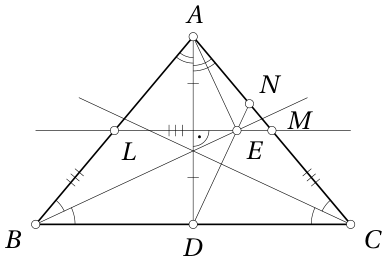
Fig. 5
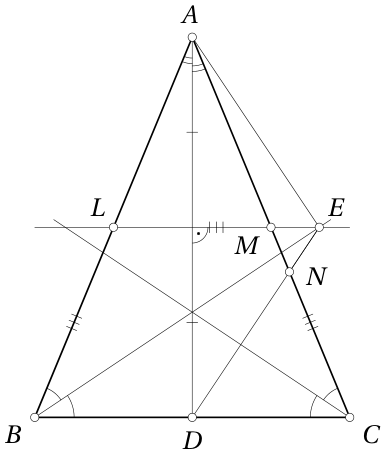
Fig. 6
Solution 4
Let be the incenter of . Clearly is the point of tangency of the incircle and side . Let be the tangency point with side (Fig. 7), then . In the isosceles triangle , the line is both the angle bisector and altitude, so and are perpendicular. It remains to show that lies on .
By the Iran lemma, the angle bisector and the extensions of the incircle chord and the midline corresponding to intersect at one point. Of those, the first and the third intersect at , so must lie on , as desired.
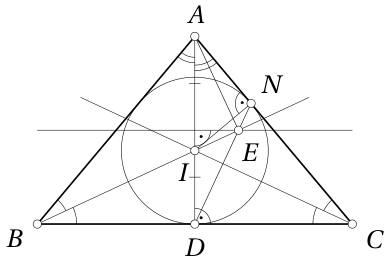
Fig. 7
Want a route through all this instead of an archive? The track
puts 2,604 problems in a working order, from Junior Challenge level to the IMO shortlist.