Maths Olympiad Prep

Library / /18 of 35

Geometry Difficulty 5.4 AIME, harder Prove it Belarus

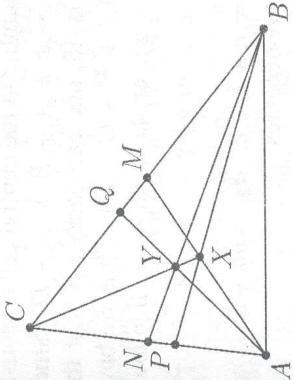
The incircle of the triangle ABCABC touches the sides ACAC and BCBC at points PP and QQ, respectively, NN and MM are the midpoints of ACAC and BCBC, respectively. Let X=AMBPX = AM \cap BP, Y=BNAQY = BN \cap AQ.
Given C,X,YC, X, Y are collinear prove that CXCX is the angle bisector of the angle ACBACB.

Solution

(Solution by V. Vityaz, A. Gaponenko.) Let without loss of generality CXCYCX \ge CY. Then APAN,BMBQAP \le AN, BM \le BQ (see the Fig.) By the Menelaus theorem, we have: for the triangle AQMAQM and the line XCXC

Figure 1

AYYQQCCMMXXA=1,(1) \frac{AY}{YQ} \cdot \frac{QC}{CM} \cdot \frac{MX}{XA} = 1, \quad (1)

for the triangle AQCAQC and the line NBNB
AYYQQBBCCNNA=1,(2) \frac{AY}{YQ} \cdot \frac{QB}{BC} \cdot \frac{CN}{NA} = 1, \quad (2)

for the triangle AMCAMC and the line PBPB
AXXMMBBCCPPA=1.(3) \frac{AX}{XM} \cdot \frac{MB}{BC} \cdot \frac{CP}{PA} = 1. \qquad (3)
Let AC=bAC = b, AB=cAB = c, BC=aBC = a, pp be the semiperimeter of the triangle ABCABC. Then (2) and (3) give AY/YQ=a/(pb)AY/YQ = a/(p-b) and MX/XA=0.5(pc)/(pa)MX/XA = 0.5(p-c)/(p-a), respectively. Substituting these equalities in (1) we get
apb2(pc)apc2(pa)=1    (pc)2=(pa)(pb)     \frac{a}{p-b} \cdot \frac{2(p-c)}{a} \cdot \frac{p-c}{2(p-a)} = 1 \iff (p-c)^2 = (p-a)(p-b) \iff
a2+b2=c(a+b)    a(pc)=b(pb)    YAYQ=CACQ, a^2 + b^2 = c(a+b) \iff a(p-c) = b(p-b) \iff \frac{YA}{YQ} = \frac{CA}{CQ},
the last proportion is equivalent to the fact that CYCY bisects the angle ACQACQ.

Want a route through all this instead of an archive? The track puts 2,000 problems in a working order, from AMC 10 level to the IMO shortlist.

Source: MathNet, licensed CC-BY-4.0. Statement and solution reproduced as published; topic and difficulty added by this site.