Maths Olympiad Prep

Library / Balkan Mathematical Olympiad competition problems /1 of 16

Balkan Mathematical Olympiad competition problems

Geometry Difficulty 5.4 AIME, harder Prove it Balkan Mathematical Olympiad

Let ABCDABCD be a convex quadrilateral such that AB2+BC2=AD2+CD2AB^2 + BC^2 = AD^2 + CD^2. Points XX and YY are chosen such that XD⊥CDXD \perp CD, XB⊥ABXB \perp AB, YB⊥BCYB \perp BC and YD⊥ADYD \perp AD. Let lines ACAC and XYXY meet at TT and MM be the midpoint of segment XYXY. Prove that points T,M,B,DT, M, B, D lie on a circle.

Solution

Let PP be the midpoint of ACAC. Applying the formula for the length of the median on △ABC\triangle ABC and △ADC\triangle ADC, and using the fact that AB2+BC2=AD2+CD2AB^2 + BC^2 = AD^2 + CD^2, we obtain BP=DPBP = DP.
Claim.∠BXA=∠PBD \text{Claim.} \quad \angle BXA = \angle PBD
Proof. We use directed angles.
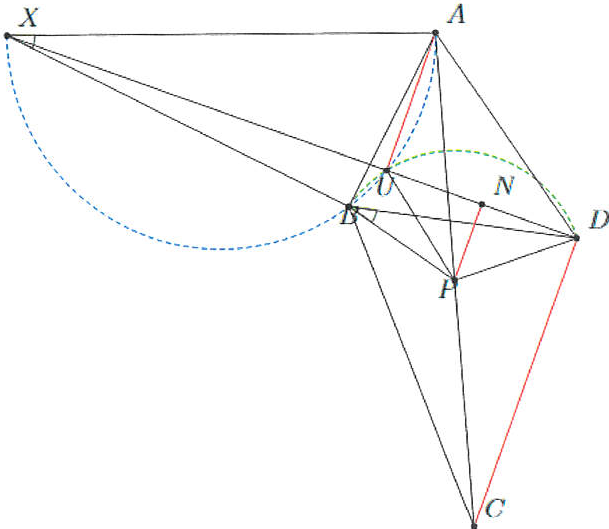
Let UU be the projection of AA onto DXDX and NN be the midpoint of UDUD.
Figure 1
Observe that AU∥CDAU \parallel CD and P,NP, N are the midpoints of AC,UDAC, UD, so PN∥CDPN \parallel CD. Since DU⊥CDDU \perp CD, we get that PU=PD=PBPU = PD = PB, so PP is the circumcenter of △DUB\triangle DUB. Also observe that A,U,B,XA, U, B, X are concyclic (∠AUX=∠ABX=90∘\angle AUX = \angle ABX = 90^\circ), so we can infer that
∠PBD=90∘−∠DUB=90∘−∠XUB=90∘−∠XAB=∠BXA. \angle PBD = 90^\circ - \angle DUB = 90^\circ - \angle XUB = 90^\circ - \angle XAB = \angle BXA.
□\Box

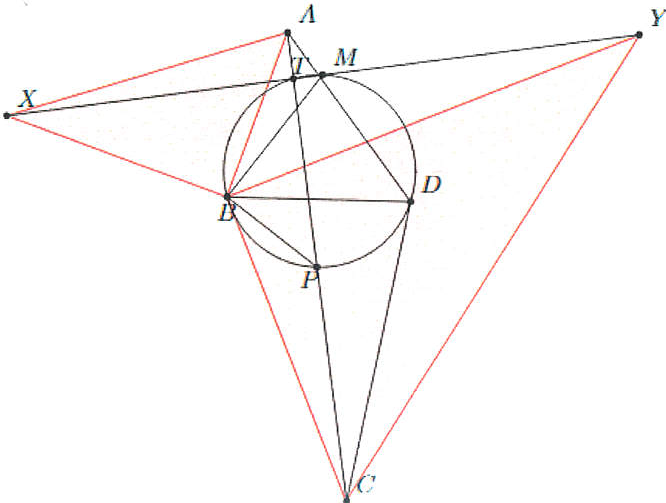
By projecting CC onto YDYD, we can similarly prove that ∠BYC=∠PBD\angle BYC = \angle PBD, so ∠BYC=∠BXA\angle BYC = \angle BXA. We also have ∠XBA=90∘\angle XBA = 90^\circ and ∠YBC=90∘\angle YBC = 90^\circ, meaning △BXA∼△BYC\triangle BXA \sim \triangle BYC. This is a spiral similarity centered at BB sending AXAX to CYCY. It follows that BB is also the center of spiral similarity sending ACAC to XYXY.
Figure 2

Since XB⊥ABXB \perp AB and YB⊥CBYB \perp CB, the angle of rotation in the spiral similarity △BAC∼△BXY\triangle BAC \sim \triangle BXY is 90∘90^\circ. This means we also have AC⊥XYAC \perp XY, thus TT is the projection of PP onto XYXY, so PT⊥TMPT \perp TM. Moreover, the spiral similarity sends PP to MM, so BP⊥BMBP \perp BM. We can similarly prove that DP⊥DMDP \perp DM, so points T,M,B,DT, M, B, D lie on the circle with diameter PMPM and we are done.

Want a route through all this instead of an archive? The track puts 2,604 problems in a working order, from Junior Challenge level to the IMO shortlist.

Source: MathNet, licensed CC-BY-4.0. Statement reproduced verbatim; metadata (topic, difficulty) added by this project.