In a graph with 8 vertices that contains no cycle of length 4, at most how many edges can there be?
Team selection tests for GMO, 2018
Solution
Let denote the set of all vertices. Let be the greatest degree of a vertex in the graph and be a vertex with degree and let be the set of vertices connected to .
In the full subgraph consisting of vertices in , no vertex can have degree 2 or more, because this would make a cycle of length 4. Therefore, there are at most edges in this full subgraph.
Similarly, none of the vertices in can have 2 or more connections to because this would also make a cycle of length 4. Therefore, there are at most edges between and . Finally, the number of edges in is at most , hence
- If , .
- If , .
- If , .
Let us now prove that is not possible by ruling out the two cases with and .
1. If and , then there are exactly 2 edges in the full subgraph consisting of vertices in (each vertex in is connected to exactly one other vertex in ), there are exactly 3 edges between and (each vertex in is connected to exactly 1 vertex in ) and there are exactly 3 edges in (all 3 of the vertices in are connected).
Let us denote the vertices in by . and cannot be connected to the same vertex in , otherwise this would make a cycle of length 4 (for example cyclically connected).
Therefore, exactly 3 of the 4 vertices in are connected to . Since each vertex in is connected to exactly one other vertex in , two of these 3 vertices are connected. Let us call them and let us assume without loss of generality that they are connected to and . Now, we have a cycle of length 4 as are cyclically connected. Therefore, and is not possible.
2. If and , then all vertices in the graph must have degree 3. Let be any vertex and be defined as above. Similarly as above, no vertex in can have 2 or more connections to as this would make a cycle of length 4.
Hence, each vertex in is connected to at most 1 vertex in and thus connected to at least 2 vertices in . If we consider the full subgraph consisting of the 4 vertices in , each vertex has degree at least 2. In a graph with 4 vertices such that each vertex has degree at least 2, there must be a cycle of length 4. Therefore, and is also not possible.
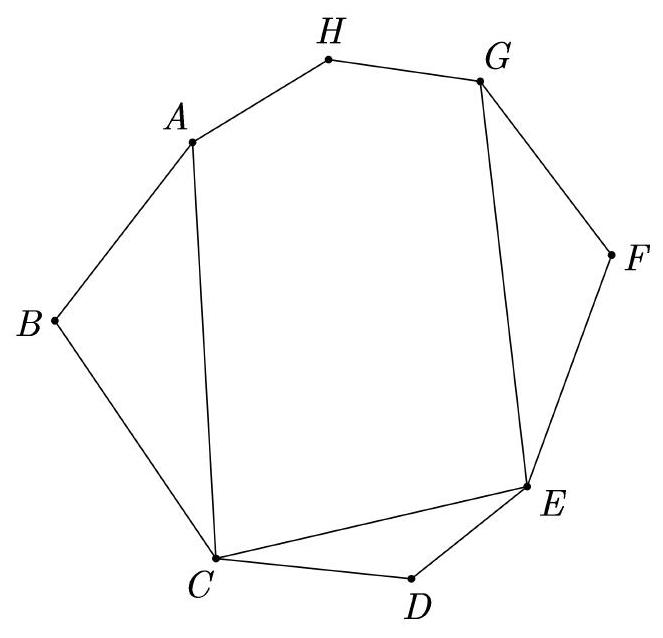
Let us now give an example of a graph with . Consider an octagon . Now, draw the additional three edges . This is a graph with 8 vertices, 11 edges and no cycles of length 4.
Want a route through all this instead of an archive? The track
puts 2,604 problems in a working order, from Junior Challenge level to the IMO shortlist.