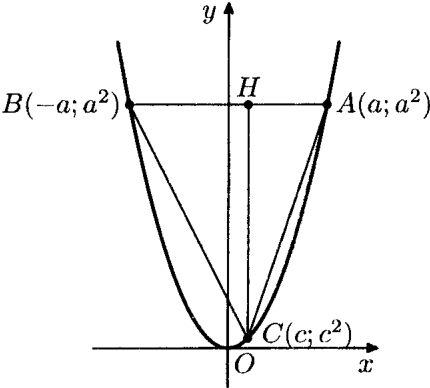
The graph of the parabola y=x2 is drawn on the Cartesian plane Oxy. A triangle ABC is inscribed in the parabola so that its side AB is parallel to the Ox axis and point C lies between the line AB and the Ox axis. It is known that the length of the side AB is 1 less than the length of the altitude CH of the triangle ABC. Find the value of the angle ACB.
Solution
Answer: ∠ACB=45∘. Let A(a;a2) and C(c;c2) (see the Fig.). Since AB∥Ox, we see that A and B are symmetric with respect to the axis Oy. Then their ordinates are equal and abscissae differ by sign. Hence B(−a;a2). Since H belongs to AB and CH∥Oy, we have H(c;a2). Then CH=a2−c2 and (without loss of generality we assume a>0) AB=2a. By condition, a2−c2=2a+1.(∗) Moreover, AH=a−c and BH=c+a. By Pythagorean theorem, from the right-angled triangle HCA and HCB we obtain CA2=(a2−c2)2+(a−c)2andCB2=(a2−c2)2+(c+a)2. By the law of cosines, from △ABC we obtain AB2=CA2+CB2−2CA⋅CB⋅cos∠ACB.
Replacing the lengths of AB, CA and CB by their obtained expressions and taking into account (∗), we obtain 4a2=(a2−c2)2+(a−c)2+(a2−c2)2+(c+a)2−2(a2−c2)2+(a−c)2(a2−c2)2+(c+a)2cos∠ACB=2(a2−c2)2+2(a2+c2)−2(a−c)(a+c)2+1(a+c)(a−c)2+1cos∠ACB=+2(a2+c2)2(a2−c2)2+2(a2+c2)−−2(a2−c2)(a2−c2)2+(a+c)2+(a−c)2+1cos∠ACB=(∗)2(2a+1)2++2(a2+a2−2a−1)−2(2a+1)(2a+1)2+2a2+2c2+1cos∠ACB==not, then from (3)12a2+4a−2(2a+1)4a2+4a+1+2a2+2(a2−2a−1)+1cos∠ACB==not, then from (3)12a2+4a−2(2a+1)8a2cos∠ACB=12a2+4a−42a(2a+1)cos∠ACB. Thus, 42a(2a+1)cos∠ACB=8a2+4a, whence cos∠ACB=1/2, and therefore, ∠ACB=45∘.
Want a route through all this instead of an archive? The track
puts 2,604 problems in a working order, from Junior Challenge level to the IMO shortlist.
Source: MathNet,
licensed CC-BY-4.0.
Statement reproduced verbatim; metadata (topic, difficulty) added by this project.