Maths Olympiad Prep

Library / /20 of 36

, 2023

Geometry Difficulty 8.6 Shortlist Prove it Baltic Way

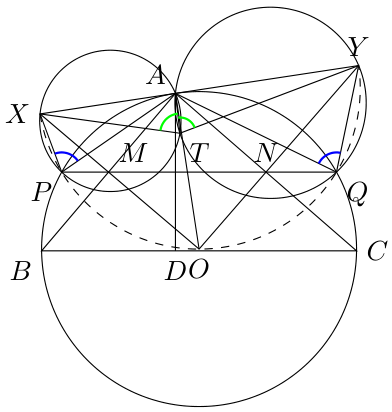
In an acute scalene triangle ABC\triangle ABC points P,QP, Q lie on the smaller arcs AB^\widehat{AB} and AC^\widehat{AC}, respectively, and are the intersection of the midline parallel to BCBC with the circumcircle of ABC\triangle ABC. Points XX and YY are the intersection of the perpendicular bisectors of segments ABAB and ACAC, respectively, with the tangent of (ABC)\odot(ABC) at point AA. Define point TAT \neq A as the intersection of (PXA)\odot(PXA) and (QYA)\odot(QYA). If ADAD is an altitude in the triangle ABC\triangle ABC, prove that
TXTY=DBDC \frac{|TX|}{|TY|} = \frac{|DB|}{|DC|}

Solution

Figure 1
Shortlist: Keep confidential!

Step 1: Points X,P,O,Q,YX, P, O, Q, Y lie on a circle.
Proof. Since point XX lies on the perpendicular bisector of ABAB, we have that XA,XBXA, XB are tangents to (ABC)\odot(ABC). This means that XAO=OBX=90\angle XAO = \angle OBX = 90^{\circ}, therefore quadrilateral OAXBOAXB is cyclic. From Power of the Point we have
XMMO=AMMB=PMMQ |XM| \cdot |MO| = |AM| \cdot |MB| = |PM| \cdot |MQ|
since quadrilateral APBQAPBQ is cyclic too. This implies that points X,P,O,QX, P, O, Q lie on the same circle. Similarly, we can prove that points Y,P,O,QY, P, O, Q lie on the same circle, so points X,P,O,Q,YX, P, O, Q, Y lie on a circle as desired. \square

Step 2: APX=YQA\angle APX = \angle YQA
Proof. Observe that XAP=AQP\angle XAP = \angle AQP. Moreover, AYP=XQP\angle AYP = \angle XQP, since quadrilateral XPQYXPQY is cyclic. We deduce that
AQX=AQPXQP=XAPAYP=APY. \angle AQX = \angle AQP - \angle XQP = \angle XAP - \angle AYP = \angle APY.
Remember that XPY=XQY\angle XPY = \angle XQY as again quadrilateral XPQYXPQY is cyclic. Consequently, we have
XPA=XPYAPY=XQYAQX=AQY \angle XPA = \angle XPY - \angle APY = \angle XQY - \angle AQX = \angle AQY
as desired. \square

Notice that XAO\triangle XAO and YAO\triangle YAO are right angle triangles, therefore
XA=AOtanACB|XA| = |AO| \cdot \tan \angle ACB and AY=AOtanCBA|AY| = |AO| \cdot \tan \angle CBA.
This means that AXAY=tanACBtanCBA\frac{|AX|}{|AY|} = \frac{\tan \angle ACB}{\tan \angle CBA}. Similarly, ABD\triangle ABD and ACD\triangle ACD are right angle triangles, therefore
AD=BDtanCBA|AD| = |BD| \cdot \tan \angle CBA and AD=CDtanACB|AD| = |CD| \cdot \tan \angle ACB.
This means that BDDC=tanACBtanCBA\frac{|BD|}{|DC|} = \frac{\tan \angle ACB}{\tan \angle CBA}. We deduce that
TXTY=AXAY=tanACBtanCBA=BDDC \frac{|TX|}{|TY|} = \frac{|AX|}{|AY|} = \frac{\tan \angle ACB}{\tan \angle CBA} = \frac{|BD|}{|DC|}
as desired. \square

Want a route through all this instead of an archive? The track puts 2,000 problems in a working order, from AMC 10 level to the IMO shortlist.

Source: MathNet, licensed CC-BY-4.0. Statement and solution reproduced as published; topic and difficulty added by this site.