Find the largest positive integer for which there exists a convex polyhedron with the following properties:
(a) has exactly edges.
(b) The degrees of the vertices of don't differ by more than .
(c) It is possible to colour the edges of with colours such that for every colour , and every pair of vertices (, ) of , there is a monochromatic path between and in the colour .
, 2022
Solutions — 2
Solution 1
We divide the solution in two steps, first we prove that , and then give an inductive construction of for .
Let have vertices, edges and faces. Suppose the contrary, that . We have disjoint trees on vertices, so . This is a contradiction as for every polyhedron we have .
Now we take and prove that for every positive integer , we can find a convex polyhedron with exactly edges that satisfies the condition of the problem.
For , let's consider the tetrahedron . One colouring that works is: , and are in one colour, and , and are in the other colour.
Suppose we have constructed , here is how to construct : Consider the triangular face most recently added to , glue on top of a truncated pyramid whose larger base is . We are effectively adding 3 new vertices, say , , , 3 faces, and 6 edges, say , , , , , . We colour , , with the first colour, and all other new edges with the second colour. It is now easy to see that in any one of the colours, a tree on the vertices of in that colour, together with the newly added edges of that colour give a tree on the vertices of in that colour.
Note that is the most recently added triangular face, so the construction can proceed inductively by glueing another truncated pyramid on top of it. It's easy to see (and prove inductively) that every vertex has degree 3 or 4, so condition (b) is satisfied and we are done.
Solution 2
For the construction we can also use Steinitz's Theorem on the characterization of convex polyhedra: A planar graph is the graph of a convex polyhedron if and only if it is 3-vertex connected. So we can take for example the graph on with edges , , , in one colour and , , , and in the other colour. It is easy to get a planar embedding of this graph as for example in the following figure for the case .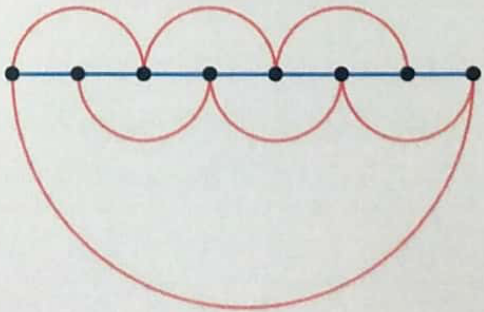
This graph is 3-connected: Suppose we remove the vertices and with . If , or , the remaining graph is obviously connected. If and the remaining graph is also connected having the spanning path . Otherwise and we have the spanning path .
This graph has edges so for it has the required number of edges. Furthermore it satisfies (b) as every vertex has degree 3 or 4.
Want a route through all this instead of an archive? The track
puts 2,000 problems in a working order, from AMC 10 level to the IMO shortlist.