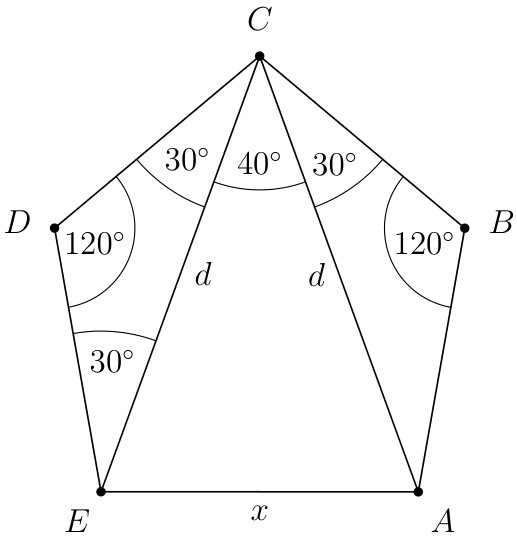
Let ABCDE be a pentagon with ∣AB∣=∣BC∣=∣CD∣=∣DE∣=1, ∠ABC=∠CDE=120∘ and ∠BCD=100∘. Determine whether ∣EA∣ is smaller, equal or larger than 1.
Solution
We connect C to A and E. Because triangles ABC and CDE are isosceles with an angle of 120∘, we have ∠BAC=∠BCA=∠DCE=∠DEC=30∘.
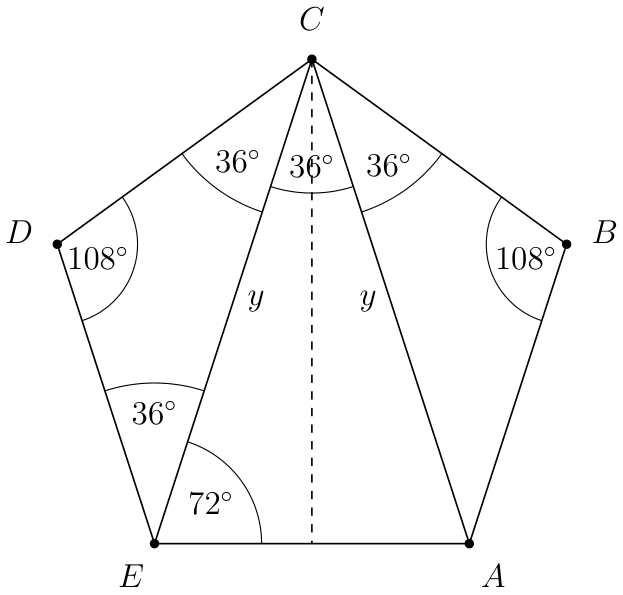
Hence, ∠ACE=40∘. Let x=∣AE∣ and d=∣CA∣=∣CE∣. The Cosine rule for △CDE gives d2=2−2cos(120∘)=3. The Cosine Rule for △ACE then says x2=2d2−2d2cos(40∘)=6(1−cos(40∘)), and so x>1 iff cos(40∘)<65. To show this, we consider a regular pentagon with side length 1 and draw two diagonals that start at the same vertex. Because the internal angles of a regular pentagon have measure 108∘, the angles are as indicated in the diagram below. Our aim is to prove cos(36∘)<5/6.
Letting y=∣CE∣=∣CA∣ and considering the perpendicular bisector of EA in triangle ACE, we obtain cos(72∘)=cos(∠AEC)=2y1. The Cosine Rule for triangle ACE gives 1=2y2−2y2cos(36∘), hence cos(36∘)=1−2y21. On the other hand, the Cosine Rule for triangle ABC tells us y2=2−2cos(108∘). Using cos(72∘)=−cos(108∘), this implies y2=2+2cos(72∘)=2+y1. Because y is opposite the largest angle in triangle ABC, it must be its largest side, i.e. y>1. Therefore, y2=2+y1<3. This then implies cos(36∘)=1−2y21<1−61=65. Finally, we obtain cos(40∘)<cos(36∘)<65 which shows that ∣EA∣=x>1 in the originally given pentagon.
Remark. From triangle ABC we obtain 1=1+y2−2ycos(36∘) (Cosine Rule) and so cos(36∘)=2y. Using our previous value, we get 2y=1−2y21, hence, after multiplying by 2y, y2=2y−y1. Comparing this with an earlier calculation gives 2y−y1=2+y1, i.e. y2−y−1=0. The positive root of this quadratic is y=21+5, the golden ratio. This gives us the precise value cos(36∘)=2y=41+5 which can easily be shown to be smaller than 5/6.
Want a route through all this instead of an archive? The track
puts 2,604 problems in a working order, from Junior Challenge level to the IMO shortlist.
Source: MathNet,
licensed CC-BY-4.0.
Statement reproduced verbatim; metadata (topic, difficulty) added by this project.