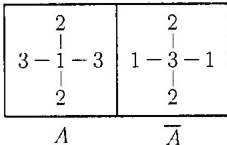
Beatriz has a winning strategy. In order to win, Beatriz has to split the board into 20182/2 horizontal dominoes and, whenever Ana occupies one cell of a domino, Beatriz in its turn must occupy the other cell of the same domino. To see that this strategy works, we may ensure that if A and Aˉ are the two cells corresponding of the same domino and Ana visits the cell A with a color that has not been previously used in A, then Beatriz may visit the cell Aˉ with a color that has not been previously used in Aˉ (and conversely).
For simplicity, we will denote the black color by 1, the grey color by 2 and the white color by 3. We may represent the colors of the faces of the cube as in Figure 1: the face that is in contact with the cell is x, the lateral faces to the left and to the right are y, and the lateral faces at the front and the back are z. For instance, the cube in Figure 2 is represented as in Figure 3.
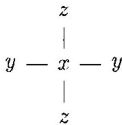
Figure 1
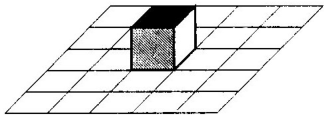
Figure 2
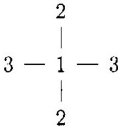
Figure 3
Now, consider the orientation of the cube, which is the order (clockwise or counter-clockwise) in which the colors 1, 2, 3 appear in the upper-right corner of its representation. For example, the cube in Figure 2 has the clockwise orientation, since the numbers 1, 2, 3 appear in the clockwise direction in Figure 3.
Note that, when making a move, the orientation of the cube changes; then, when the cube comes back to a cell, its orientation is the same as the orientation in its previous visit to that cell (since an even number of moves is necessary for the cube to come back to a cell). Consider now a horizontal domino with two cells A,Aˉ and assume, without loss of generality, that the cube has the clockwise orientation in the cell A (the other case is similar). Hence, it will always have the clockwise orientation in the cell A and the counter-clockwise orientation in the cell Aˉ. Therefore, if Ana puts the cube in one of these cells and Beatriz were not able to put it in the other one without color repetition, then Ana should have repeated color in her turn, since Aˉ is visited with color 1 if and only if A is visited with color 2, Aˉ is visited with color 2 if and only if A is visited with color 3, and Aˉ is visited with color 3 if and only if A is visited with color 1.
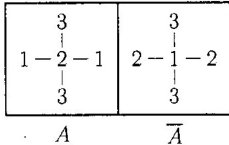
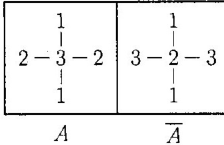
We conclude that, if Ana can make a valid move, then Beatriz also can in her turn, so Beatriz does not lose the game. Since the game eventually ends, Beatriz wins by following the described strategy.
