In triangle , we have . Let be a point on the bisector of angle such that . Let be a point on line such that and . Prove that the midpoint of the line segment belongs to the line .
Bogdan Antohe
In triangle , we have . Let be a point on the bisector of angle such that . Let be a point on line such that and . Prove that the midpoint of the line segment belongs to the line .
Bogdan Antohe
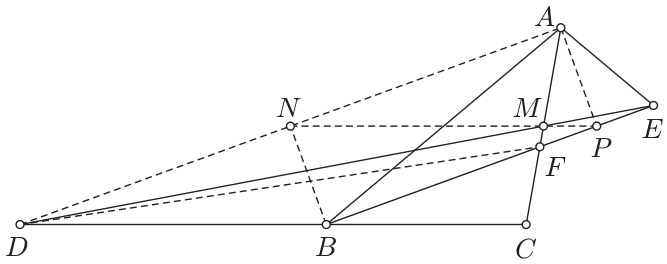
Let be the midpoint of ; it follows that . If , ; then the quadrilateral is a rectangle.
Since the points and are the projections of on the interior and exterior bisectors of the angle , respectively, it follows that the line contains the midline parallel to , and hence .
Let ; from it follows that and , hence the triangle is isosceles, with , and we deduce that is the midpoint of the line segment .
In the trapezoid , the points and are the midpoints of the bases, therefore the line contains the point of intersection of trapezoid's diagonals and . Since , it follows that .