a) Let (I) touch CA, AB at U,V; Ib,Ic be the excenters of vertices B,C in triangle ABC. Clearly, IaA, IbB and IcC are three altitudes of triangle IaIbIc. On the other hand, notice that IA⊥UV, IB⊥VD, IC⊥DU so two triangles DUV and IaIbIc have corresponding parallel sides. So there exists a homothety H that turns D into Ia, U into Ib and V into Ic.
Through H, I becomes O′ which is the circumcenter of triangle IaIbIc. However, in triangle IaIbIc, I is the orthocenter and (ABC) is the Euler circle, so O belongs to IO′, which implies the center of H belongs to OI. On the other hand, notice that the center of H also lies on DIa; DIa and OI intersect at L so we infer that L is the center of H.
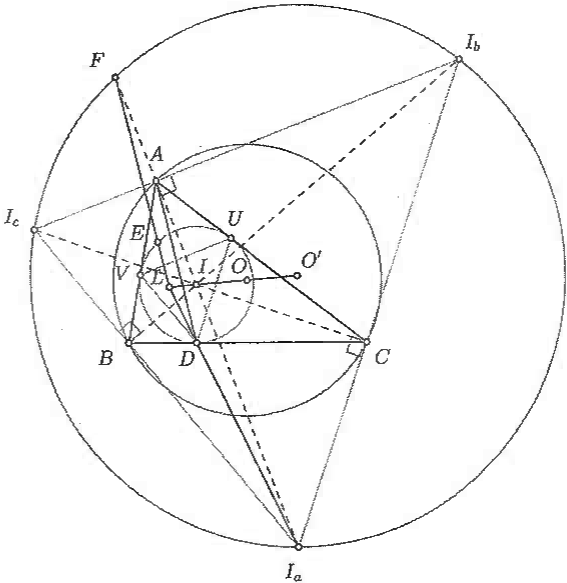
We have L,E,F are collinear and DE∥IaF so F is the image of E via the above homothety, so it lies on (IaIbIc). Furthermore, notice that triangle IaIbIc has I as the orthocenter and IaF as the altitude, so we infer that F and I are symmetric through IcIb, hence, AF=AI.
b) It is easy to see that J is the midpoint of the minor arc BC of (O), which is a fixed point. Let K be the intersection of MN with the perpendicular bisector of BC, we will prove that K is a fixed point, it follows that T always moves on a circle of diameter JK, which is a fixed circle. Let S be the midpoint of BC, then because BC and IcIb are anti-parallel, then IaS is the symmedian of triangle IaIbIc. Since the tangents at U and V of (I) intersect at A, DA is the symmedian of the triangle DUV. Moreover, the homothety H turns triangle DUV into triangle IaIbIc so we infer that the image of DA through this homothety is IaS. So IaS∥AD, infer that Ia,S and M are collinear.
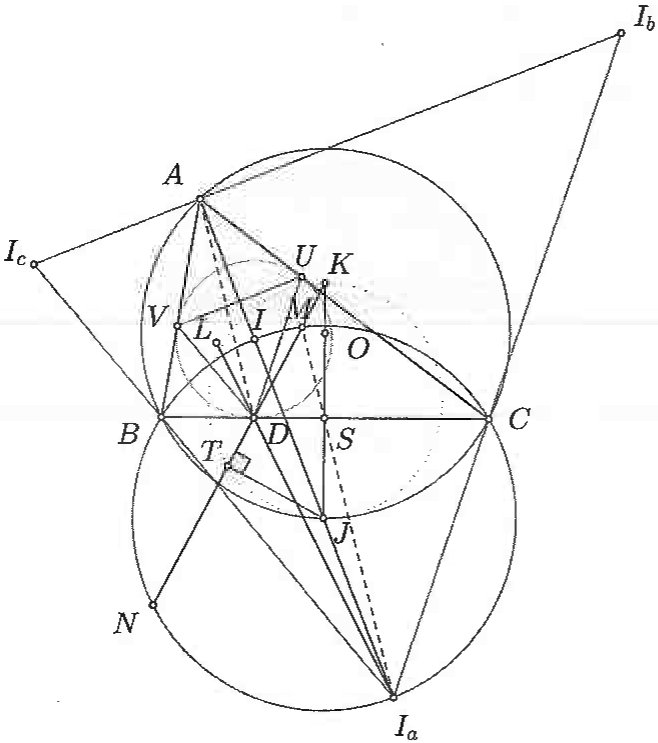
The tangent lines at B and C of (J) intersect at Q, we will prove that K is fixed by showing that K is the midpoint of SQ.
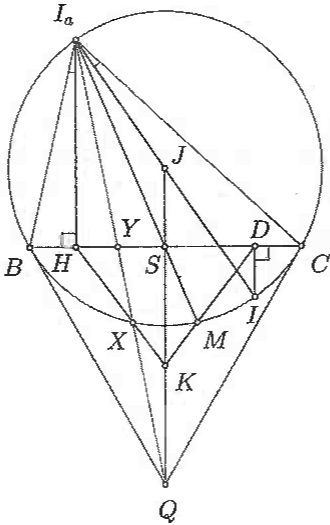
Let H be the projection of Ia on BC. We have IaH and IaJ are isogonal with respect to angle BIaC, so it is easy to see BH=DC, i.e. H and D are symmetric with respect to S. Let IaQ meet (J) again at X and meet BC at Y. We have IaQ is the symmedian of triangle IaBC, so X and M are symmetric through BC, which implies XH passes through K.
On the other hand, we have (QY,XIa)=−1 so H(QY,XIa)=−1. Since QS is parallel to HIa then K is the midpoint of SQ. □