72
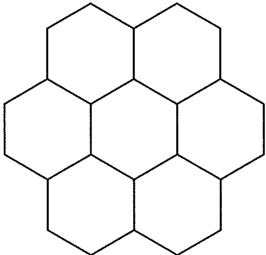
Since the sum of the integers in any two adjacent cells must be at most 10, the only possible integers that can appear in the neighbors of the cell containing 7 are 1, 2, or 3. Therefore, the cell labeled 7 cannot be the central cell, and there are exactly 6 possible cells in which to place the 7.
By symmetry, the total number of labelings is 6 times the number of labelings in which the leftmost cell contains 7. Suppose the leftmost cell contains 7, and denote this cell by A. We classify the other six cells into three groups, B, C, and D, as shown in the left diagram below.
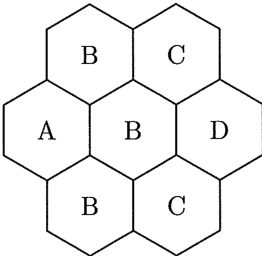
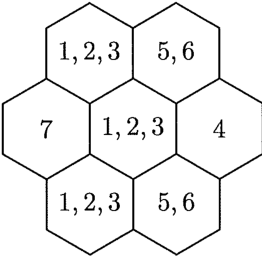
The three cells in group B are all adjacent to A, so they must be labeled with 1, 2, or 3 in some order. The remaining three cells in groups C and D must be labeled with 4, 5, and 6. Since the two cells labeled 5 and 6 are not adjacent to each other, both of them must lie in group C (which consists of two cells), and the cell in group D must be labeled 4.
Conversely, any labeling satisfying these assignments clearly meets the condition that each pair of adjacent cells sums to at most 10. There are 3! ways to assign {1,2,3} to the three cells in B, and 2! ways to assign {5,6} to the two cells in C. Hence the total number of labelings is 6⋅(3!⋅2!)=72.