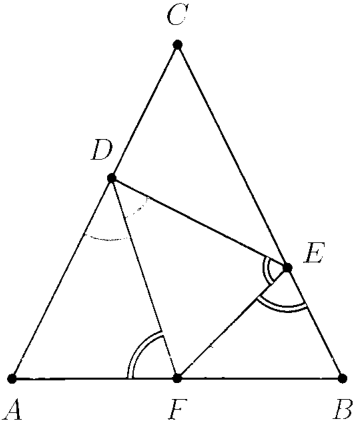
Let be an isosceles triangle with the apex at . Let and be two points on the sides and , such that the angle bisectors and meet at , which lies on the segment . Prove that is the midpoint of .
Slovenia — National Math Olympiad
Solution
Denote , and . The triangle is isosceles with the apex at , so . The segments and bisect the angles and , so and .
The sum of the inner angles of a quadrilateral is equal to . Hence, for the quadrilateral we have
which implies .
The sum of the inner angles of a triangle is , so , and . The triangles , and have all three inner angles in common, so they are similar. This implies that
or
We have shown that is the midpoint of the segment .
Want a route through all this instead of an archive? The track
puts 2,604 problems in a working order, from Junior Challenge level to the IMO shortlist.