Let A1(0;a1), B1(b1;0), C1(c1;0), D1(0;d1), A(a;1/a), B(b;1/b), C(c;1/c), D(d;1/d) be the marked points. Since any vertical and any horizontal line meets the hyperbola y=1/x at most at one point we see that the numbers a, b, c, d are pairwise distinct.
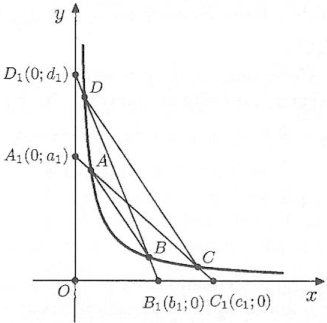
The equation of the line AB has the form y−a1=k1(x−a). Since point B belongs to the line AB its coordinates must satisfy the line equation, i.e. b1−a1=k1(b−a), so k1=−ab1.
Similarly, for the line CD we have y−c1=k2(x−c), and so
k2=−cd1. Since AB∥CD we have k1=k2, so
ab=cd⟹ca=db.(1)
The equation of the line AC has the form y−a1=k(x−a). Setting x=0 in this equation, we find the ordinate of A1: a1=a1−ka, and setting y=0 in the equation we find the abscissa of C1: c1=a−ka1. Since point C belongs to the line AC its coordinates must satisfy the line equation, i.e. c1−a1=k(c−a), so k=−ac1. Therefore a1=a1+c1 and c1=a+c.
Similarly, from the equation of the line BD we find d1=b1+d1 and b1=b+d.
Therefore,
S(A1OC1)=21∣a1c1∣=21⋅∣ac∣(a+c)2=21⋅∣a/c∣(a/c+1)2,
S(D1OB1)=21∣b1d1∣=21⋅∣bd∣(b+d)2=21⋅∣b/d∣(b/d+1)2.
Now from (1) it follows that S(A1OC1)=S(D1OB1).