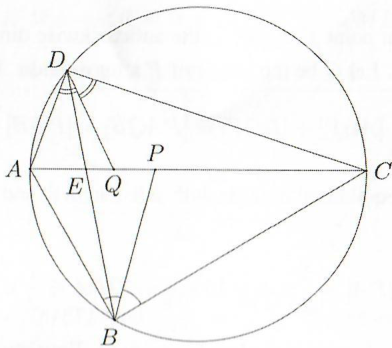
Let ABCD be a cyclic quadrilateral and E be the intersection of AC and BD. P and Q are two points on AC such that the points A, E, Q, P, C lie on the same straight line in this order, and that BP bisects ∠ABC whereas DQ bisects ∠ADC. If AE=4, EQ=2 and QP=3, find the length of PC.
Solution
Note that sin∠DAB=sin∠DCB as the two angles are supplementary. Using [XYZ] to denote the area of XYZ, we have ECAE=[DCB][DAB]=21⋅DC⋅BC21⋅AD⋅AB=BCAB⋅DCAD(1) By the angle bisector theorem, we have BCAB=PCAPandDCAD=QCAQ It follows from (1) that ECAE=PCAP⋅QCAQ Setting PC=x and using the given side lengths, this becomes 5+x4=x9⋅3+x6 Solving gives x=15 or x=−29, and of course the latter is rejected.
Want a route through all this instead of an archive? The track
puts 2,604 problems in a working order, from Junior Challenge level to the IMO shortlist.
Source: MathNet,
licensed CC-BY-4.0.
Statement reproduced verbatim; metadata (topic, difficulty) added by this project.