Maths Olympiad Prep

Library / USA IMO /27 of 29

USA IMO, 2003

Geometry Difficulty 9.1 IMO level Prove it United States

Let AH1‾\overline{AH_1}, BH2‾\overline{BH_2}, and CH3‾\overline{CH_3} be the altitudes of an acute scalene triangle ABCABC. The incircle of triangle ABCABC is tangent to BC‾\overline{BC}, CA‾\overline{CA}, and AB‾\overline{AB} at T1,T2T_1, T_2, and T3T_3, respectively. For k=1,2,3k = 1, 2, 3, let PiP_i be the point on line HiHi+1H_iH_{i+1} (where H4=H1H_4 = H_1) such that HiTiPiH_iT_iP_i is an acute isosceles triangle with HiTi=HiPiH_iT_i = H_iP_i. Prove that the circumcircles of triangles T1P1T2T_1P_1T_2, T2P2T3T_2P_2T_3, T3P3T1T_3P_3T_1 pass through a common point.

Solution

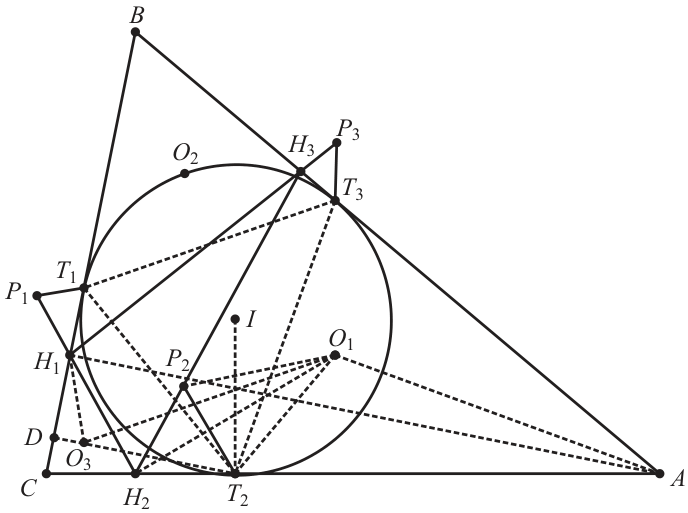
First Solution. (By Po-Ru Loh) We begin by showing that points O3,H2,T2O_3, H_2, T_2, and O3O_3 lie on a cyclic. We will prove this by establishing ∠O3O1H2=∠O3T2C=∠O3T2H2\angle O_3O_1H_2 = \angle O_3T_2C = \angle O_3T_2H_2. To find ∠O3O1H2\angle O_3O_1H_2, observe that triangles H2AH3H_2AH_3 and H2H1CH_2H_1C are similar. Indeed, quadrilateral BH3H2CBH_3H_2C

Figure 1

is cyclic so ∠H2H3A=∠C\angle H_2H_3A = \angle C, and likewise ∠CH1H2=∠A\angle CH_1H_2 = \angle A. Now, O1O_1 and O3O_3 are corresponding incenters of similar triangles, so it follows that triangles H2AO1H_2AO_1 and H2H1O3H_2H_1O_3 are also similar, and hence are related by a spiral similarity about H2H_2. Thus,
AH2H1H2=O1H2O3H2 \frac{AH_2}{H_1H_2} = \frac{O_1H_2}{O_3H_2}
and
∠AH2H1=∠AH2O1+∠O1H2H1=∠O1H2H1+∠H1H2O3=∠O1H2O3. \begin{aligned} \angle AH_2H_1 &= \angle AH_2O_1 + \angle O_1H_2H_1 \\ &= \angle O_1H_2H_1 + \angle H_1H_2O_3 = \angle O_1H_2O_3. \end{aligned}
It follows that another spiral similarity about H2H_2 takes triangle H2AH1H_2AH_1 to triangle H2O1O3H_2O_1O_3. Hence ∠O3O1H2=∠H1AH2=90∘−∠C\angle O_3O_1H_2 = \angle H_1AH_2 = 90^\circ - \angle C.
We wish to show that ∠O3T2C=90∘−∠C\angle O_3T_2C = 90^\circ - \angle C as well, or in other words, T2O3⊥BCT_2O_3 \perp BC. To do this, drop the altitude from O3O_3 to BCBC and let it intersect BCBC at DD. Triangles ABCABC and H1H2CH_1H_2C are similar as before, with corresponding incenters II and O3O_3. Furthermore, IT2IT_2 and O3DO_3D also correspond. Hence, CT2/T2A=CD/DH1CT_2/T_2A = CD/DH_1, and so T2D∥AH1T_2D \parallel AH_1. Thus, T2D⊥BCT_2D \perp BC, and it follows that T2O3⊥BCT_2O_3 \perp BC.

Figure 2

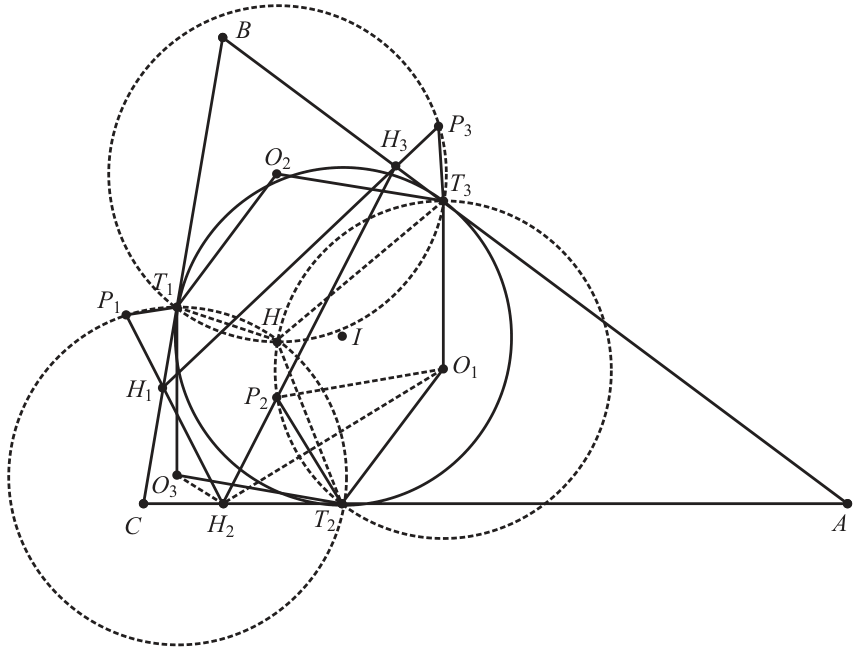
Having shown that O1H2T2O3O_1H_2T_2O_3 is cyclic, we may now write ∠O1T2O3=∠O1H2O3\angle O_1T_2O_3 = \angle O_1H_2O_3. Since triangles H2AO1H_2AO_1 and H2H1O3H_2H_1O_3 are related by a spiral similarity about H2H_2, we have
∠O1H2O3=∠AH2H1=180∘−∠B, \angle O_1H_2O_3 = \angle AH_2H_1 = 180^\circ - \angle B,
by noting that ABH2H1ABH_2H_1 is cyclic. Likewise,
∠O2T3O1=180∘−∠Cand∠O3T1O2=180∘−∠A, \angle O_2T_3O_1 = 180^\circ - \angle C \quad \text{and} \quad \angle O_3T_1O_2 = 180^\circ - \angle A,
and so ∠O1T2O3+∠O2T3O1+∠O3T1O2=360∘\angle O_1T_2O_3 + \angle O_2T_3O_1 + \angle O_3T_1O_2 = 360^\circ. Therefore, ∠T3O1T2\angle T_3O_1T_2, ∠T1O2T3\angle T_1O_2T_3, and ∠T2O3T1\angle T_2O_3T_1 of hexagon O1T2O3T1O2T3O_1T_2O_3T_1O_2T_3 also sum to 360∘360^\circ. Now let HH be the intersection of circles ω1\omega_1 and ω2\omega_2. Then ∠T2HT3=180∘−12∠T3O1T2\angle T_2HT_3 = 180^\circ - \frac{1}{2}\angle T_3O_1T_2 and ∠T3HT1=180∘−12∠T1O2T3\angle T_3HT_1 = 180^\circ - \frac{1}{2}\angle T_1O_2T_3. Therefore,
∠T1HT2=360∘−∠T2HT3−∠T3HT1=12∠T3O1T2+12∠T1O2T3=180∘−12∠T1O3T2, \begin{aligned} \angle T_1HT_2 &= 360^\circ - \angle T_2HT_3 - \angle T_3HT_1 \\ &= \frac{1}{2}\angle T_3O_1T_2 + \frac{1}{2}\angle T_1O_2T_3 = 180^\circ - \frac{1}{2}\angle T_1O_3T_2, \end{aligned}
and so HH lies on the circle ω3\omega_3 as well. Hence, circles ω1\omega_1, ω2\omega_2, and ω3\omega_3 share a common point, as wanted.

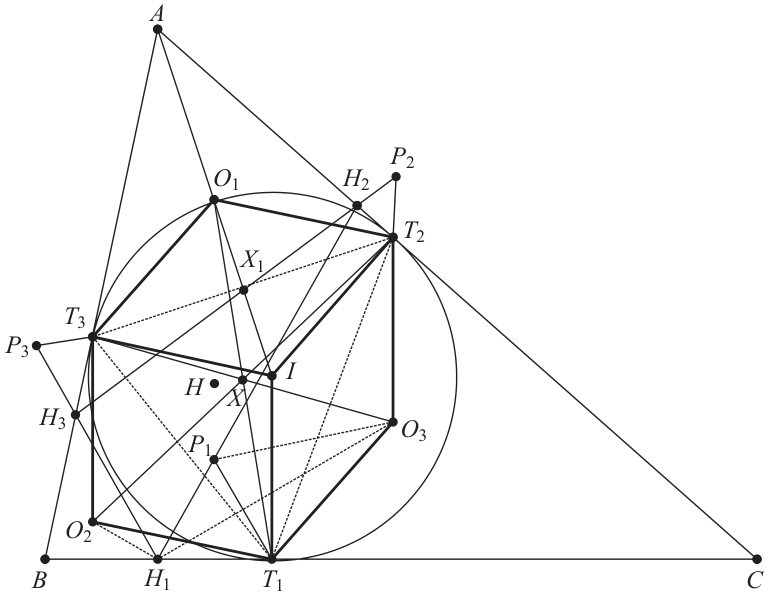
Second Solution. (By Anders Kaseorg) Note that AH2=ABcos⁡∠AAH_2 = AB \cos \angle A and AH3=ACcos⁡∠AAH_3 = AC \cos \angle A, so triangles AH2H3AH_2H_3 and ABCABC are similar with ratio cos⁡∠A\cos \angle A. Thus, since O1O_1 is the incenter of triangle AH2H3AH_2H_3, AO1=AIcos⁡∠AAO_1 = AI \cos \angle A. If X1X_1 is the intersection of segments AIAI and T2T3T_2T_3,

Figure 3

we have ∠IX1T2=∠AT2I=90∘\angle IX_1T_2 = \angle AT_2I = 90^\circ, and so
X1I=T2Icos⁡∠T2IA=AIcos⁡2∠T2IA=AIsin⁡2∠A2=AI⋅1−cos⁡∠A2=AI−AO12=O1I2. \begin{aligned} X_1I = T_2I \cos \angle T_2IA &= AI \cos^2 \angle T_2IA = AI \sin^2 \frac{\angle A}{2} \\ &= AI \cdot \frac{1 - \cos \angle A}{2} = \frac{AI - AO_1}{2} = \frac{O_1I}{2}. \end{aligned}
Hence O1X1=X1IO_1X_1 = X_1I, so O1O_1 is the reflection of II across line T2T3T_2T_3, and O1T2=IT2=IT3=O1T3O_1T_2 = IT_2 = IT_3 = O_1T_3. Therefore, O1T2IT3O_1T_2IT_3, and similarly O2T3IT1O_2T_3IT_1 and O3T1IT2O_3T_1IT_2, are rhombi with the same side length rr, implying that circles ω1,ω2,ω\omega_1, \omega_2, \omega have the same radius rr. We also conclude that O1T2=T3I=O2T1O_1T_2 = T_3I = O_2T_1 and O1T2∥T3I∥O2T1O_1T_2 \parallel T_3I \parallel O_2T_1, and so O1O2T1T2O_1O_2T_1T_2 is a parallelogram. Hence the midpoints of O1T1O_1T_1 and O2T2O_2T_2 (similarly O3T3O_3T_3) are the same point PP, and O1O2O3O_1O_2O_3 is the reflection of T1T2T3T_1T_2T_3 across PP. If HH is the reflection of II across PP, we have O1H=O2H=O3H=rO_1H = O_2H = O_3H = r, that is, HH is a common point of the three circumcircles.

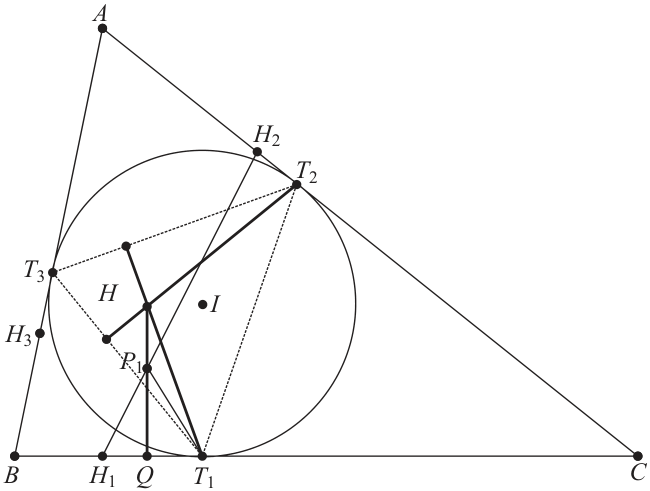
Third Solution. We use directed lengths (along line BCBC, with CC to BB as the positive direction) and directed angles modulo 180∘180^\circ in this proof. (For segments not lying on line BCBC, we assume its direction as the direction of its projection on line BCBC.) We claim that ωi\omega_i, i=1,2,3i = 1, 2, 3, all pass through HH, the orthocenter of triangle T1T2T3T_1T_2T_3. Without loss of generality, it suffices to prove that T1P1T2HT_1P_1T_2H is cyclic. If AB=ACAB = AC, then T1=H1=P1T_1 = H_1 = P_1 and the case is trivial. Let AB=cAB = c, BC=aBC = a, CA=bCA = b, ∠BAC=α\angle BAC = \alpha, ∠CBA=β\angle CBA = \beta, and ∠ACB=γ\angle ACB = \gamma.

Figure 4

Let QQ be the intersection of lines HP1HP_1 and BCBC. Note that
∠HT2T1=90∘−∠T2T1T3=90∘−[180∘−∠T3T1B−∠CT1T2]=90∘−[180∘−(90∘−β2)−(90∘−C2)]=α2. \begin{align*} \angle HT_2T_1 &= 90^\circ - \angle T_2T_1T_3 \\ &= 90^\circ - [180^\circ - \angle T_3T_1B - \angle CT_1T_2] \\ &= 90^\circ - \left[180^\circ - \left(90^\circ - \frac{\beta}{2}\right) - \left(90^\circ - \frac{C}{2}\right)\right] \\ &= \frac{\alpha}{2}. \end{align*}
(Likewise, ∠T2T1H=β/2\angle T_2T_1H = \beta/2.) Thus to prove that T1P1T2HT_1P_1T_2H is cyclic is equivalent to prove that ∠QP1T1=α/2\angle QP_1T_1 = \alpha/2.
Let QHQ_H and QPQ_P be the respective feet of perpendiculars from HH and P1P_1 to line BCBC. Because ∠AH1B=∠AH2B=90∘\angle AH_1B = \angle AH_2B = 90^\circ, ABH1H2ABH_1H_2 is cyclic, and so ∠T1H1P1=∠BH1P1=α\angle T_1H_1P_1 = \angle BH_1P_1 = \alpha. Thus triangles AT3T2AT_3T_2 and H1T1P1H_1T_1P_1

are similar, implying that
∠QPP1T1=90∘−∠P1T1H1=90∘−(90∘−∠T1H1P12)=α2. \angle Q_P P_1 T_1 = 90^\circ - \angle P_1 T_1 H_1 = 90^\circ - \left( 90^\circ - \frac{\angle T_1 H_1 P_1}{2} \right) = \frac{\alpha}{2}.
Therefore, to prove that ∠QPP1T1=α/2\angle Q_P P_1 T_1 = \alpha/2, we have now reduced to proving that QP=QHQ_P = Q_H, or
T1QPT1H1=T1QHT1H1.(1) \frac{T_1 Q_P}{T_1 H_1} = \frac{T_1 Q_H}{T_1 H_1}. \qquad (1)
Note that
T1H1=P1H1andT1QPT1H1=1−QPH1T1H1, T_1 H_1 = P_1 H_1 \quad \text{and} \quad \frac{T_1 Q_P}{T_1 H_1} = 1 - \frac{Q_P H_1}{T_1 H_1},
that is,
T1QPT1H1=1−QPH1P1H1=1−cos⁡∠T1H1P1=1−cos⁡α.(2) \frac{T_1 Q_P}{T_1 H_1} = 1 - \frac{Q_P H_1}{P_1 H_1} = 1 - \cos \angle T_1 H_1 P_1 = 1 - \cos \alpha. \quad (2)
On the other hand, applying the Law of Cosines to triangle ABCABC gives
T1H1=T1C−H1C=a+b−c2−bcos⁡γ=a+b−c2−a2+b2−c22a=a(b−c)−(b2−c2)2a, \begin{aligned} T_1 H_1 &= T_1 C - H_1 C = \frac{a+b-c}{2} - b \cos \gamma \\ &= \frac{a+b-c}{2} - \frac{a^2+b^2-c^2}{2a} = \frac{a(b-c) - (b^2-c^2)}{2a}, \end{aligned}
or
T1H1=(b−c)(a−b−c)2a=(c−b)(b+c−a)2a.(3) T_1 H_1 = \frac{(b-c)(a-b-c)}{2a} = \frac{(c-b)(b+c-a)}{2a}. \quad (3)
Now we calculate T1QHT_1 Q_H. Because HH is the orthocenter of triangle T1T2T3T_1 T_2 T_3,
∠T1HT2=180∘−∠HT2T1−∠T2T1H=(90∘−∠HT2T1)+(90∘−∠T2T1H)=∠T2T1T3+∠T3T2T1=180∘−∠T1T3T2. \begin{aligned} \angle T_1 H T_2 &= 180^\circ - \angle H T_2 T_1 - \angle T_2 T_1 H \\ &= (90^\circ - \angle H T_2 T_1) + (90^\circ - \angle T_2 T_1 H) \\ &= \angle T_2 T_1 T_3 + \angle T_3 T_2 T_1 = 180^\circ - \angle T_1 T_3 T_2. \end{aligned}
Applying the Law of Sines to triangle T1T2HT_1 T_2 H and applying the Extended Law of Sines to triangle T1T2T3T_1 T_2 T_3 gives
T1Hsin⁡∠HT2T1=T1T2sin⁡∠T1HT2=T1T2sin⁡∠T1T3T2=2r, \frac{T_1 H}{\sin \angle H T_2 T_1} = \frac{T_1 T_2}{\sin \angle T_1 H T_2} = \frac{T_1 T_2}{\sin \angle T_1 T_3 T_2} = 2r,
and consequently,
T1H=2rsin⁡α2. T_1 H = 2r \sin \frac{\alpha}{2}.
Because
∠QHT1H=∠CT1T2+∠T2T1H=(90∘−γ2)+β2=90∘+β−γ2, \begin{aligned} \angle Q_H T_1 H &= \angle CT_1 T_2 + \angle T_2 T_1 H = (90^\circ - \frac{\gamma}{2}) + \frac{\beta}{2} \\ &= 90^\circ + \frac{\beta - \gamma}{2}, \end{aligned}
we obtain
T1QH=T1Hcos⁡∠HT1QH=2rsin⁡α2sin⁡γ−β2.(4) T_1 Q_H = T_1 H \cos \angle H T_1 Q_H = 2r \sin \frac{\alpha}{2} \sin \frac{\gamma - \beta}{2}. \quad (4)
Combining equations (1), (2), (3), and (4), we conclude that it suffices to prove that
1−cos⁡α=4arsin⁡α2sin⁡γ−β2(c−b)(b+c−a).(5) 1 - \cos \alpha = \frac{4ar \sin \frac{\alpha}{2} \sin \frac{\gamma-\beta}{2}}{(c-b)(b+c-a)}. \quad (5)
Applying the fact
sin⁡α2cos⁡α2=tan⁡α2=rAT2=2rb+c−a, \frac{\sin \frac{\alpha}{2}}{\cos \frac{\alpha}{2}} = \tan \frac{\alpha}{2} = \frac{r}{AT_2} = \frac{2r}{b+c-a},
and applying the Law of Sines to triangle ABCABC, (5) becomes
1−cos⁡α=2sin⁡αsin⁡2α2sin⁡γ−β2cos⁡α2(sin⁡γ−sin⁡β).(6) 1 - \cos \alpha = \frac{2 \sin \alpha \sin^2 \frac{\alpha}{2} \sin \frac{\gamma-\beta}{2}}{\cos \frac{\alpha}{2} (\sin \gamma - \sin \beta)}. \quad (6)
By the Double-angle formulas, 1−cos⁡α=2sin⁡2α21 - \cos \alpha = 2 \sin^2 \frac{\alpha}{2} and sin⁡α=2sin⁡α2cos⁡α2\sin \alpha = 2 \sin \frac{\alpha}{2} \cos \frac{\alpha}{2} and so (6) reads
sin⁡γ−sin⁡β=2sin⁡α2sin⁡γ−β2. \sin \gamma - \sin \beta = 2 \sin \frac{\alpha}{2} \sin \frac{\gamma - \beta}{2}.
By the Difference-to-product formulas, the last equation reduces to
2cos⁡β+γ2sin⁡γ−β2=2sin⁡α2sin⁡γ−β2, 2 \cos \frac{\beta + \gamma}{2} \sin \frac{\gamma - \beta}{2} = 2 \sin \frac{\alpha}{2} \sin \frac{\gamma - \beta}{2},
which is evident.

Want a route through all this instead of an archive? The track puts 2,604 problems in a working order, from Junior Challenge level to the IMO shortlist.

Source: MathNet, licensed CC-BY-4.0. Statement reproduced verbatim; metadata (topic, difficulty) added by this project.