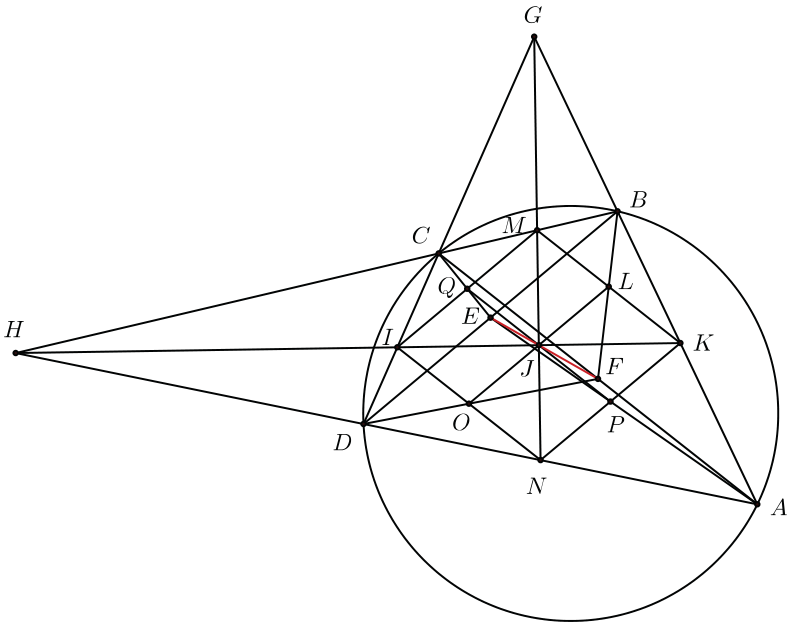
We are going to treat only the case when C∈(GD) and C∈(BH), all the other cases being similar.
a) Let M and N be the intersection points of the angle bisector of angle ∠G with the sides BC and AD, respectively. Consider I,K the intersection points of the angle bisector of angle ∠H with sides CD and AB, respectively. Also, put {J}=MN∩IK. From triangle GBC we get ∠G=180∘−∠GBC−∠GCB=∠B+∠C−180∘, hence ∠CMJ=90∘+21(∠B−∠C). Similarly, ∠CIJ=90∘+21(∠D−∠C). From the quadrilateral CMJI, using the fact that ∠B+∠D=180∘, it follows that ∠MJI=90∘.
In the triangles GIK and HMN, line segments [GJ] and [HJ] are angle bisectors and altitudes, therefore they are also medians. Thus, the diagonals of the quadrilateral MKNI are perpendicular and bisect each other.
b) The sides of the rhombus are parallel to AC and BD, respectively. Indeed, according to the angle bisector theorem, MCMB=GCGB and KABK=HAHB. But from the power of the point G with respect to the circle, GCGB=GAGD. In order to prove that MK∥AC, i.e. KABK=MCBM, it is sufficient to prove that HA⋅GD=HB⋅GA. This follows from [AHG]=2HA⋅GDsinD=2HB⋅GAsinB and sinB=sinD. Thus, MK∥AC.
Consider {L}=MK∩BF, {P}=AE∩KN, {O}=DF∩IN and {Q}=MI∩CE. Line segments AE,BF,CE and DF are medians in triangles ABD,ABC,BCD,CDA, therefore LO and PQ meet in the center of the rhombus.
Put {X}=LO∩EF and {Y}=QP∩EF. Then XFXE=LFLB=KABK and YFYE=QCQE=MCBM. As KABK=MCBM, it follows that points X and Y coincide, which means that the lines EF,LO and PQ pass through the center of the rhombus.