Altitudes of an acute scalene triangle meet at point . Points and are the midpoints of the segments and , respectively. is the foot of the perpendicular from to line . is the second intersection of the line with the circumcircle of triangle . Let be the circumcentre of the triangle formed by the lines , and . Prove that the lines and are perpendicular.
Silk Road Mathematical Competition
Solutions — 2
Solution 1
We will make several uses of the fact that the lines connecting a vertex of a triangle with the circumcentre and the orthocentre are symmetrical with respect to the angle bisector at this vertex.
Let , and be the altitudes of the triangle , its circumcentre. The points , and lie on the circle with diameter . The triangles and are similar, and their similarity ratio is . Then the ratio of the circumradii of these triangles is also , that is, , hence . Since , is a parallelogram. Let , , . Then, since , we have , whence, and the lines and are symmetrical with respect to the bisector of . Since and , we have , that is, , , and belong to the same circle with diameter (here ). The desired perpendicularity follows immediately.
Note. We have proved in this solution that lies on the symmedian of the triangle .
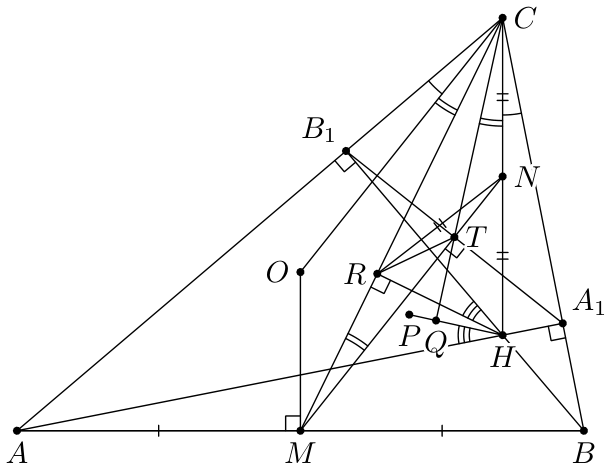
Solution 2
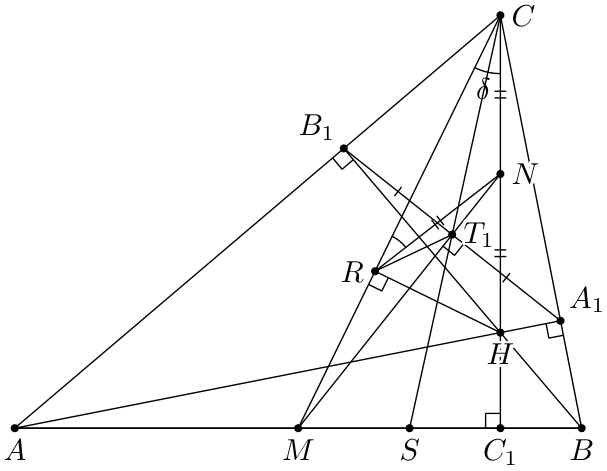
Let , , and be the altitudes of the triangle , and the midpoint of . Then , , therefore is the perpendicular bisector of . We will prove that .
Since and are respective medians in similar triangles and , while and are anti-parallel, lies on the symmedian of the triangle . Let . Then , hence , that is, , and it follows that belongs to the circumcircle of the triangle .
Next, as in the first solution, we can prove . The proof is indeed complete.
Want a route through all this instead of an archive? The track
puts 2,604 problems in a working order, from Junior Challenge level to the IMO shortlist.