We use A,B,C,D to represent these four colors, respectively, and the points in the same color by lower letters as a1,a2,a3;b1,b2,b3;c1,c2,c3 and d1,d2,d3 respectively.
Now consider color A. If, in n quadrilaterals, the number of points a1,a2,a3 in color A are n1,n2,n3 respectively, then n1+n2+n3=n. Suppose that n1≥n2≥n3. If n≥10, then n1+n2≥7. Consider these seven quadrilaterals (its A color vertex is either a1 or a2), if the numbers of points b1,b2,b3 in color B are m1,m2,m3, respectively, then m1+m2+m3=7. By symmetricity, we may suppose that m1≥m2≥m3, then m3≤2, that is, m1+m2≥5.
Consider these five quadrilaterals (its A color point is either a1 or a2, and its B color point is either b1 or b2), if the numbers of points c1,c2,c3 in color C are k1,k2,k3, respectively, then k1+k2+k3=5. By symmetricity, we may suppose that k1≥k2≥k3, then k3≤1, that is, k1+k2≥4.
Consider these four quadrilaterals, denoted as T1,T2,T3,T4 (its color A point is either a1 or a2, its color B point is either b1 or b2, and its color C point is either c1 or c2). Since there are only three points in color D, there are two quadrilaterals that have the same color D point. Suppose that the same color D point of T1,T2 is d1.
Then, in three quadrilaterals T1,T2,T3, whatever be the color of the vertex, there are repeated points, which contradicts condition (2). Hence, n≤9.
We show the maximal number n=9 by construction of these nine quadrilaterals.
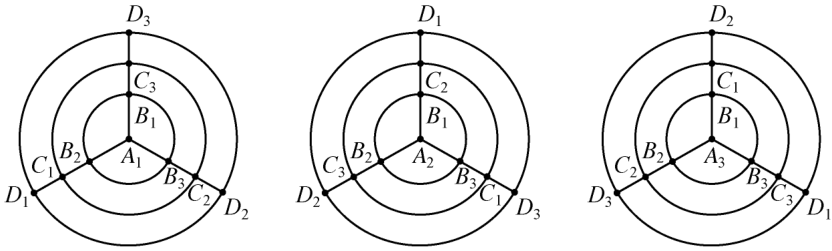
We draw three “concentric annulus” with four points on each radius representing four vertices and the color. So nine radii represent nine quadrilaterals, which satisfy condition (1).
Next, we show that they also satisfy condition (2). Take any three radii (or three quadrilaterals).
If these three radii come from a concentric annulus, for each color except A, there are three points.
If these three radii come from three concentric annuli, then for color A, there are three points.
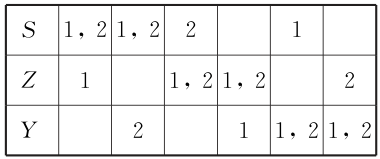
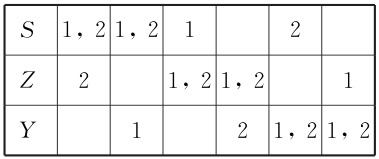
If these three radii come from two concentric annuli, call these three figures Fig. 1, Fig. 2 and Fig. 3. The radius directions are called “up radius”, “left radius” and “right radius”, and denoted, respectively, by S, Z and Y. If three radii have three directions, then there are three points of color B in three quadrilaterals. If the three radii have only two directions, then there are all cases as shown in the tables below, where 1, 2 and 3 stand for Fig. 1, Fig. 2 and Fig. 3, respectively.
Here, the color in figure means that the three quadrilaterals have color with different figures.
C
D
C
D
C
D
Thus, the maximal number of n is 9. □