Denote by OB the center of the excircle that touches AC, and by E the center of the nine-point circle (fig. 23). Points E, I and F, as well as the points E, FB and OB lie on the same line since F and FB are the tangent points of the circles with the corresponding centers. Besides, E=I, since otherwise the circles either would not have any common points or would coincide. Taking this into account, if the point E lies on the line IOB, i.e. on a bisector of the angle B, then the points F and FB lie on this line as well. Then the lines IF and BFB both coincide with the bisector.
Now, suppose E lies outside the line IOB. Point FB is on the side EOB of triangle EIOB since the circles touch externally. In contrast, B lies on the continuation of the side OBI of this triangle. Hence, the line BFB intersects the line EI=IF at some point XB, moreover, XB is the inner point of segment EI. Now we can apply Menelaus's theorem to the triangle EIOB and line passing through the points B, XB and FB:
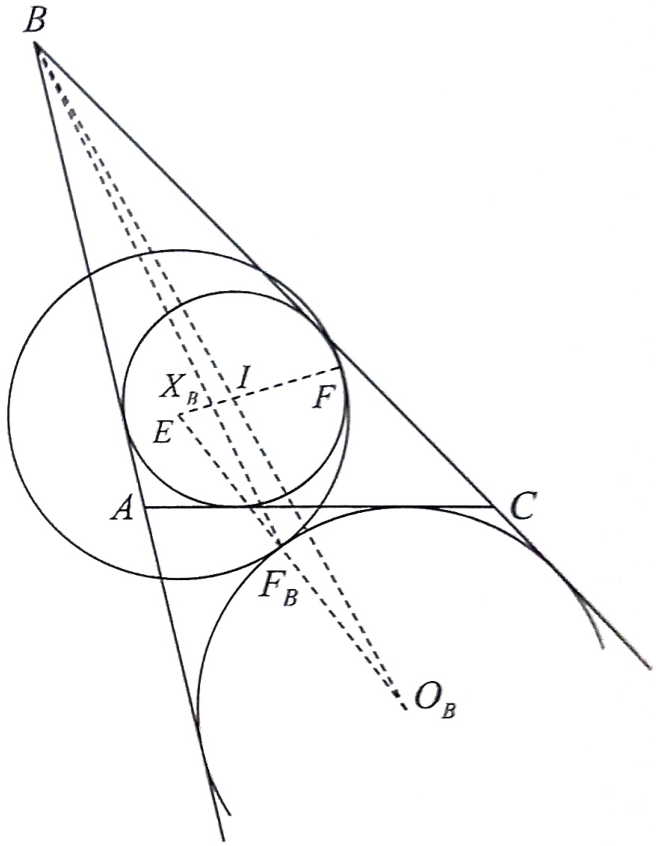
Fig. 23
XBIEXB⋅BOBIB⋅FBEOBFB=1.
Denote by r the radius of the incircle of triangle ABC, by rB the radius of its excircle that touches side AC, and by R9 the radius of the nine-point circle. If we drop the perpendiculars-radiuses II′ and OBOB′ from the points I and OB to the line AB, it will form similar right triangles BII′ and BOBOB′ with the similarity coefficient BIBOB=II′OBOB′=rrB. It means that
XBIEXB=IBBOB⋅OBFBFBE=rrB⋅rBR9=rR9.
Thus, line BFB passes through the unique point X from the segment EI which satisfies XIEX=rR9. The same is also true in the case when E lies on the line IOB, because, as shown above, in this case all points of the segment EI belong to the line BFB.
By similar reasoning it follows that the lines AFA and CFC pass through the same point X∈EI, which satisfies XIEX=rR9. To finish the proof, it remains to mention that point X, as well as the whole segment EI, also belongs to the line IF.