Maths Olympiad Prep

Library / /6 of 19

Geometry Difficulty 5.6 AIME, harder Prove it Romania

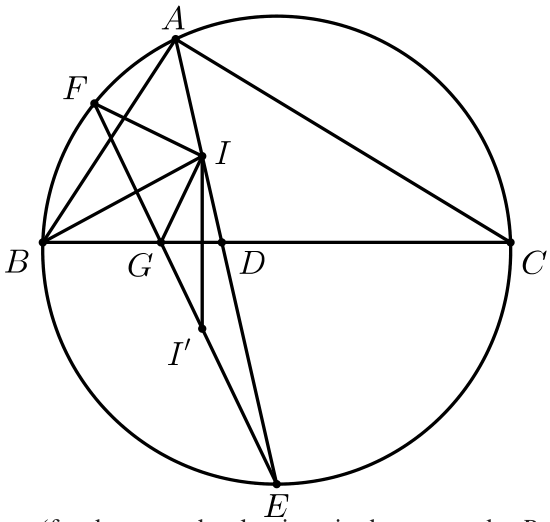
Let II be the incenter of the scalene triangle ABCABC, with AB<ACAB < AC, and let II' be the reflection of point II in the line BCBC. The angle bisector AIAI meets the side BCBC at DD and the circumcircle of ABCABC at EE. The line EIEI' meets the circumcircle at FF. Prove that AIIE=IDDE\frac{AI}{IE} = \frac{ID}{DE} and IA=IFIA = IF.

Solutions — 2

Solution 1

We have AIID=ABBD=ECDE=BEDE=IEDE\frac{AI}{ID} = \frac{AB}{BD} = \frac{EC}{DE} = \frac{BE}{DE} = \frac{IE}{DE}, which proves the first relation.

Let G=EFBCG = EF \cap BC. We know that GDGD is the bisector of the angle EGI\angle EGI, hence GIGE=IDDE=AIIE\frac{GI}{GE} = \frac{ID}{DE} = \frac{AI}{IE}. (1)

Triangles FBEFBE and BGEBGE are similar (AA), therefore EB2=EFEG=EI2EB^2 = EF \cdot EG = EI^2. This means that triangles FIEFIE and IGEIGE are also similar (SAS), which leads to FIIE=GIGE\frac{FI}{IE} = \frac{GI}{GE}. (2)

From (1) and (2) we obtain FI=AIFI = AI, and the conclusion.

Figure 1

Solution 2

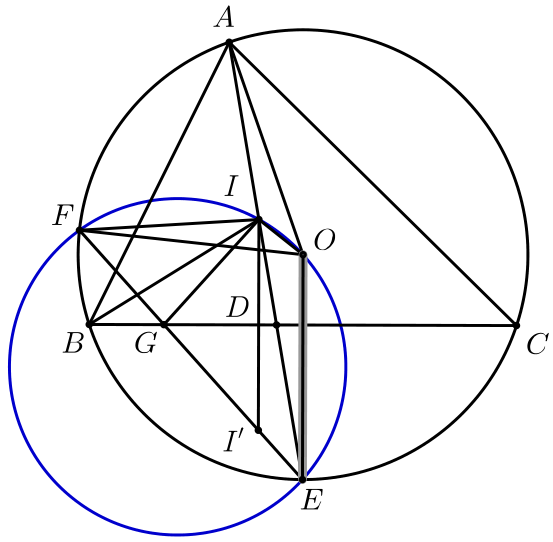
Let OO be the circumcenter of triangle ABCABC. We show that triangles AIOAIO and IIEII'E are similar, which proves that the points I,O,F,EI, O, F, E are co-cyclic.

OEOE and IIII' are both perpendicular to BCBC, hence they are parallel. It follows that IIEOEIOAI\angle I'IE \equiv \angle OEI \equiv \angle OAI.

We prove that AIII=AOIE\frac{AI}{II'} = \frac{AO}{IE}. From the angle bisector theorem we obtain AIID=ABBD=ACCD=AB+ACBC=b+ca\frac{AI}{ID} = \frac{AB}{BD} = \frac{AC}{CD} = \frac{AB + AC}{BC} = \frac{b+c}{a}, hence AIAD=b+ca+b+c\frac{AI}{AD} = \frac{b+c}{a+b+c}. As AD=la=2bccosA2b+cAD = l_a = \frac{2bc \cos \frac{A}{2}}{b+c}, we obtain AI=2bccosA2a+b+cAI = \frac{2bc \cos \frac{A}{2}}{a+b+c}.

But IE=EBIE = EB and EBBC=sinA2sinA=12cosA2\frac{EB}{BC} = \frac{\sin \frac{A}{2}}{\sin A} = \frac{1}{2 \cos \frac{A}{2}}. Moreover, EI=EB=a2cosA2EI = EB = \frac{a}{2 \cos \frac{A}{2}}.

It follows that, AIIE=abca+b+cAI \cdot IE = \frac{abc}{a+b+c}.

Figure 2

On the other hand, AOII=R2r=2RSp=abca+b+cAO \cdot II' = R \cdot 2r = \frac{2RS}{p} = \frac{abc}{a+b+c}, hence AOII=AIIEAO \cdot II' = AI \cdot IE, which, together with IIEOAI\angle I'IE \equiv \angle OAI, proves the similarity of the triangles AIOAIO and IIEII'E.

We deduce that EIOIIFOEFOFE\angle EIO \equiv \angle II'F \equiv \angle OEF \equiv \angle OFE, hence IOEFIOEF is cyclic (the order of the points and the arguments depend slightly on the configuration).

It follows that IOFIEIAOI\angle IOF \equiv \angle IEI' \equiv \angle AOI. We also have IAOIEOIFO\angle IAO \equiv \angle IEO \equiv \angle IFO, which means that triangles AIOAIO and IFOIFO are congruent (SAA), therefore IF=IAIF = IA.

Figure 2

Want a route through all this instead of an archive? The track puts 2,000 problems in a working order, from AMC 10 level to the IMO shortlist.

Source: MathNet, licensed CC-BY-4.0. Statement and solution reproduced as published; topic and difficulty added by this site.