a.
First, consider an empty rectangle board of size 2k×2018 and 2k binary sequences of length k. We write those sequences to the left of the board so that each row consists of a sequence. Thus, the rest to the right of the board are 2018−k empty columns. It is obvious that each of the first k columns of the board (counting from the left) has exactly 2k−1 0s and 2k−1 1s. This board satisfies the given condition. We will prove that it is minimal.
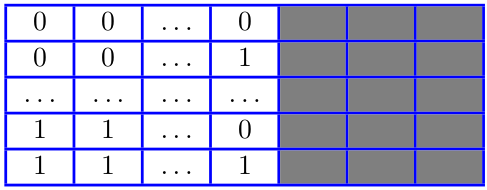
For an arbitrary binary sequence s=a1a2…a2018, we consider its subsequence s′=a1a2…ak. It is clear that s′ appears at the beginning of some row in the board, so if we continue writing ak+1,ak+2,…,a2018 into the empty cells on that row, we will get s. Furthermore, there is exactly one row that contains s′, so if we omit that row, we cannot form s from any other row. Therefore, the above board is minimal.
b.
Suppose that each of the first k columns of the board consists of both 0 and 1. We will prove the following important remark.
Remark. All the cells in the last 2018−k columns (in other words, 2018−k columns to the right) of the board are empty.
Proof. Consider an arbitrary binary sequence s of length k and suppose As be the set of rows with the property: the first k cells of each row (counting from the left) form s. We will prove that there exists an element in As of which all last 2018−k cells are empty.
Consider the (k+1)-th cell of each row in As. It is clear that those cells belong to the (k+1)-th column of the board which do not simultaneously have 0 and 1.
If no cell of this column is empty, we can suppose that all numbers in the column are 0s. Then the binary sequence of form s concatenation to 1 cannot be formed by any row, which contradicts the complete property of the board. Thus, there exists a subset A′ of A such that the (k+1)-th cell of each row in A′ is empty.
We continue considering the (k+2)-th cell and we can similarly prove that there exists a subset As′′ of As′ such that the (k+2)-th cell of each row in As′′ is empty. Following the same pattern to the last column, we will have a row of which all cells from the (k+1)-th position to the last position are empty.
Therefore, for any binary sequence s of length k, we can always find a row of which 2018−k last cells are empty. Note that these rows are not necessarily distinct since a row can form many binary sequences. Let A be the set of all such rows.
By the definition of A, it is clear that any binary sequence of length 2018 can be formed by an element of A. It is also obvious that every row in the board belongs to A, otherwise we can omit that row and the board is still complete, which contradicts the minimal property of the board. Thus A is also the set of all rows in the board, which implies the last 2018−k columns of the board are empty. The remark is proved.
Since the sub-board formed by the last 2018−k columns is totally empty, it can represent any binary sequence of length 2018−k. Moreover, the original board is minimal which implies that the sub-board formed by the first k columns is also minimal.
Erasing all 2018−k columns, the rest is a sub-board of size m×k. We number the row from 1 to m (from top to bottom) and let Ai (i=1,2,…,m) be the set of all binary sequences of length k that can be formed by the i-th row.
Since the original board is minimal with respect to binary sequences of length 2018, it follows that the above m×k sub-board is also minimal with respect to the binary sequences of length k. Set B=A1∪A2∪⋯∪Am, it is clear that ∣B∣=2k (since the sub-board can generate any binary sequence of length k).
For every i (i=1,2,…,m), there exists a binary sequence of length k generated by the i-th row, otherwise we can omit the i-th row and the remaining rows can also generate all binary sequences of length k, which contradicts the minimal property of the sub-board. This means for every i, there exists a binary sequence ai such that ai∈Ai⊂B and ai∈/Aj for any j=i. This implies ∣B∣≥m.
Combining all above arguments, we have m≤2k, which is our desired conclusion. ■