Let be a cyclic quadrilateral. Suppose that there exists a line , which is tangent to the inscribed circles of triangles and . Prove that the line contains the incenter of one of and .
(Fedir Yudin)
Ukrainian National Mathematical Olympiad, Third Round, Second Tour
Solution
Suppose it's false, wlog . Let and be the bisectors of the correspondent angles in triangles and , and and be the points symmetric to the points and with respect to the lines and correspondingly (fig. 20). Then lines and are symmetric with respect to the line , so is tangent to the inscribed circle of , similarly is tangent to the inscribed circle of .
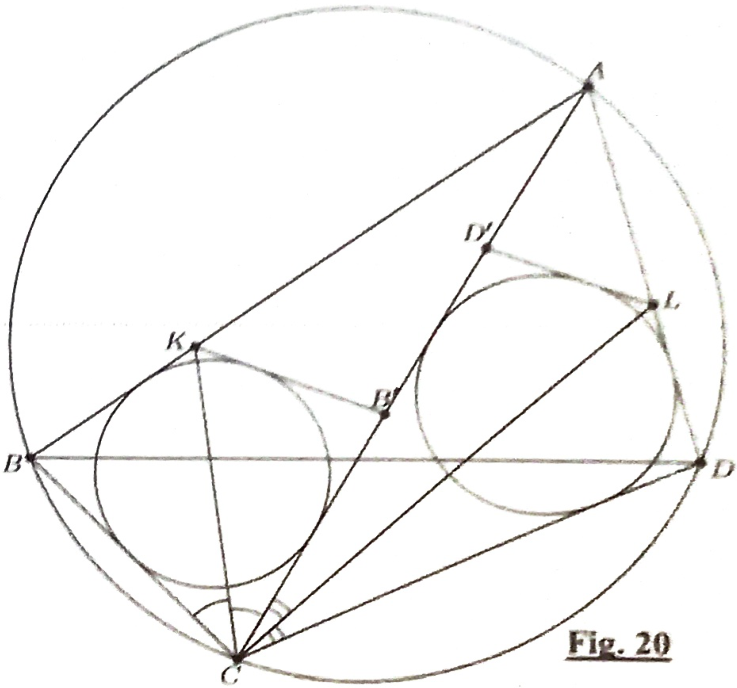
Fig. 20
Denote by the oriented distance from the point to the line , where .
Note that , implying
so . Similarly, , so . Also note that
Consider the line , with respect to which the points and lie on different sides. Then the inscribed circle of lies on the same side from the line , as the segment (as this circle lies in the quadrilateral , which lies on this side with respect to ) and the inscribed circle of has a point, lying from the different side with respect to (as it's tangent to the segment , which lies from the different side with respect to ). So these inscribed circles can't have a common tangent, parallel to , which lies on the same side from , as point , this contradiction completes the proof.
Also note that when is the midpoint of arc , we have , so is the incenter of (fig. 21). Furthermore, , so . Similarly , so the line is the common tangent.
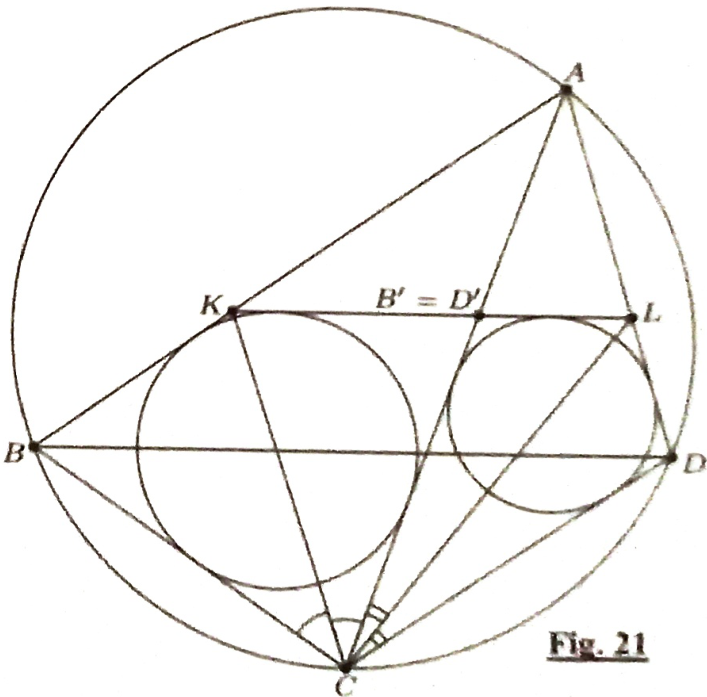
Fig. 21
Want a route through all this instead of an archive? The track
puts 2,604 problems in a working order, from Junior Challenge level to the IMO shortlist.