Maths Olympiad Prep

Library / /17 of 24

, 2019

Geometry Difficulty 8.7 Shortlist Prove it Balkan Mathematical Olympiad

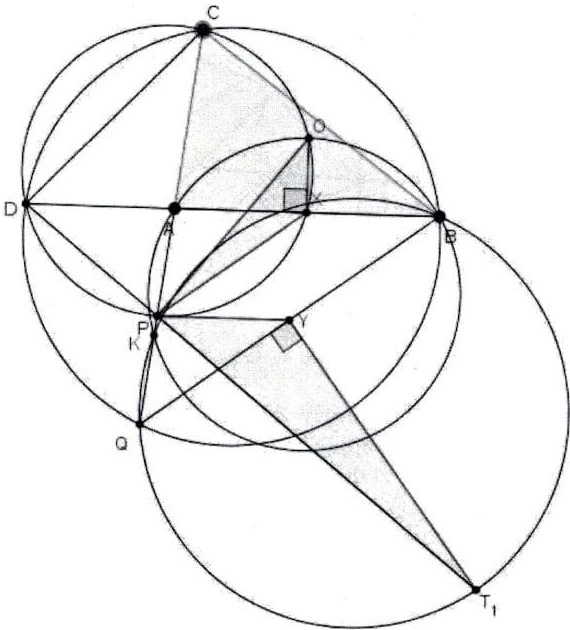
Let ABC\triangle ABC (BC>ACBC > AC) be an acute triangle with circumcircle kk centered at OO. The tangent to kk at CC intersects the line ABAB at the point DD. The circumcircles of triangles BCDBCD, OCDOCD and AOBAOB intersect the ray CACA (beyond AA) at the points QQ, PP and KK, respectively, such that P(AK)P \in (AK) and K(PQ)K \in (PQ). The line PDPD intersects the circumcircle of triangle BKQBKQ at the point TT, so that PP and TT are in different halfplanes with respect to BQBQ. Prove that TB=TQTB = TQ.

Solution

As DCDC is tangent to kk at CC then OCD=90\angle OCD = 90^\circ. Denote by XX the midpoint of ABAB. Then OXA=90\angle OXA = 90^\circ because OXOX is the perpendicular bisector of the side ABAB. The pentagon PXOCDPXOCD is inscribed in the circle with diameter ODOD, hence PXA=PXD=PCD=QCD=QBA\angle PXA = \angle PXD = \angle PCD = \angle QCD = \angle QBA (the latter is due to QBCDQBCD being cyclic). We deduce that PXQBPX \parallel QB and that PP is the midpoint of AQAQ, so AP=PQAP = PQ.

Figure 1
Figure 5: G5

Now let T1T_1 be the midpoint of the arc BQBQ, not containing KK, from the circumcircle of BKQ\triangle BKQ, then T1B=T1QT_1B = T_1Q. Due to DPO=90\angle DPO = 90^\circ, it suffices to show that OPT1=90\angle OPT_1 = 90^\circ – indeed, TT1T \equiv T_1 and TB=TQTB = TQ would follow.

Denote by YY the midpoint of BQBQ. Then OXB=T1YB=90\angle OXB = \angle T_1YB = 90^\circ. The quadrilateral QKBT1QKBT_1 is inscribed in a circle, hence BT1Q=180BKQ=AKB\angle BT_1Q = 180^\circ - \angle BKQ = \angle AKB. Then XBO=12AKB=12BT1Q=BT1Y\angle XBO = \frac{1}{2}\angle AKB = \frac{1}{2}\angle BT_1Q = \angle BT_1Y and thus OXBBYT1\triangle OXB \sim \triangle BYT_1. The quadrilaterals PXBYPXBY

and AXYPAXYP are parallelograms, since XYXY and PYPY are middle lines of the triangle AQBAQB.

Consequently,
OXXP=OXBY=XBT1Y=PYT1Y \frac{OX}{XP} = \frac{OX}{BY} = \frac{XB}{T_1Y} = \frac{PY}{T_1Y'}
which along with PXB=PYB\angle PXB = \angle PYB and OXB=T1YB\angle OXB = \angle T_1YB gives OXP=PYT1\angle OXP = \angle PYT_1 and
OXPPYT1\triangle OXP \sim \triangle PYT_1. Thus XPO=YT1P\angle XPO = \angle YT_1P and POX=T1PY\angle POX = \angle T_1PY.

In conclusion,
OPT1=XPY+XPO+YPT1=PXA+XPO+XOP=90 \angle OPT_1 = \angle XPY + \angle XPO + \angle YPT_1 = \angle PXA + \angle XPO + \angle XOP = 90^\circ
\Box

Want a route through all this instead of an archive? The track puts 2,000 problems in a working order, from AMC 10 level to the IMO shortlist.

Source: MathNet, licensed CC-BY-4.0. Statement and solution reproduced as published; topic and difficulty added by this site.