Maths Olympiad Prep

Library / /23 of 42

Combinatorics Difficulty 5.5 AIME, harder Prove it Ireland

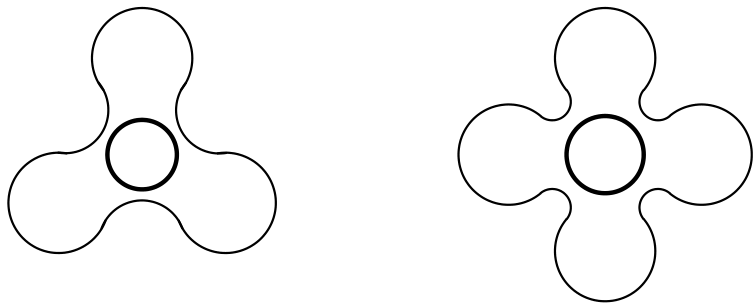
For n2n \ge 2, an n-spinner is a “fidget spinner” with nn identical arms and an angle of 360/n360/n degrees between pairs of adjacent arms. For instance, a 33-spinner and a 44-spinner are illustrated below:
Figure 1

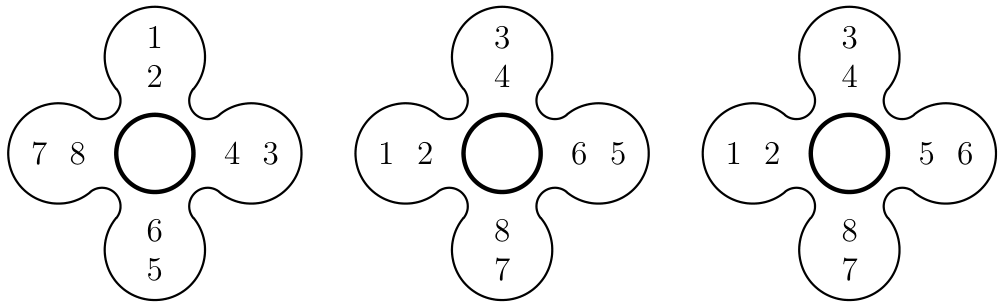
We wish to place each of the numbers 1,,nm1, \ldots, nm on the arms of an nn-spinner, with mm numbers placed on each arm, all equally spaced in a row. Some possibilities for (n,m)=(4,2)(n, m) = (4, 2) are illustrated below.
Figure 2

Since the first two can be obtained by rotation from each other, they are considered to be the same, and so we count the above as only two different placements. (The third is genuinely different because the “5” is closer to the middle than it is in the other two.) Counting in this manner, how many different placements do we obtain for given n2n \ge 2 and m1m \ge 1?

Solution

First, place the spinner so that the arm containing the number 11 is at the top. There, it can be put in any of the mm positions on that arm. This orients the nn-spinner and breaks the symmetry. The other nm1nm - 1 numbers can now be placed in any other positions, so the answer is m(nm1)!m(nm - 1)!.

Alternatively, we place all numbers as we wish, giving (nm)!(nm)! permutations. We then divide by nn since each placement can be rotated to nn different equivalent placements. Since m(nm1)!=(nm)!/nm(nm - 1)! = (nm)!/n, the answers are consistent.

Want a route through all this instead of an archive? The track puts 2,000 problems in a working order, from AMC 10 level to the IMO shortlist.

Source: MathNet, licensed CC-BY-4.0. Statement and solution reproduced as published; topic and difficulty added by this site.