Maths Olympiad Prep

Library / /76 of 100

Geometry Difficulty 5.6 AIME, harder Prove it China

The lengths of the nine edges of regular triangular prism ABCA1B1C1ABC-A_1B_1C_1 are equal, PP is the midpoint of CC1CC_1, and the dihedral angle BA1PB1=αB-A_1P-B_1 = \alpha. Then sinα=\sin \alpha = \underline{\hspace{2cm}}.

Solutions — 2

Solution 1

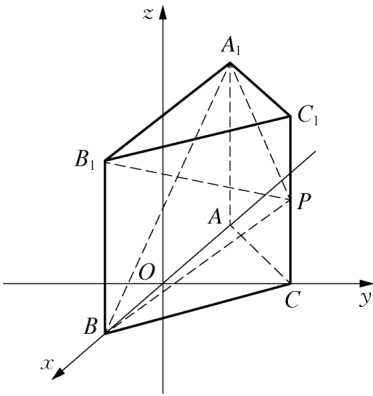
Let the line through segment ABAB be xx-axis with the origin OO being the midpoint of ABAB and let the line through segment OCOC be yy-axis to establish a space rectangular coordinate system shown in Fig. 7.1. Assuming the length of an edge is 2, we have B(1,0,0)B(1, 0, 0), B1(1,0,2)B_1(1, 0, 2), A1(1,0,2)A_1(-1, 0, 2), P(0,3,1)P(0, \sqrt{3}, 1). Then
Figure 1
Fig. 7.1
BA1=(2,0,2),BP=(1,3,1),B1A1=(2,0,0),B1P=(1,3,1). \begin{aligned} \overrightarrow{BA_1} &= (-2, 0, 2), \quad \overrightarrow{BP} = (-1, \sqrt{3}, 1), \\ \overrightarrow{B_1A_1} &= (-2, 0, 0), \quad \overrightarrow{B_1P} = (-1, \sqrt{3}, -1). \end{aligned}
Let vectors m=(x1,y1,z1)\vec{m} = (x_1, y_1, z_1) and n=(x2,y2,z2)\vec{n} = (x_2, y_2, z_2) be perpendicular to BA1PBA_1P and B1A1PB_1A_1P, respectively. We have
{mBA1=2x1+2z1=0,mBP=x1+3y1+z1=0,nB1A1=2x2=0,nB1P=x2+3y2z2=0. \begin{cases} \vec{m} \cdot \overrightarrow{BA_1} = -2x_1 + 2z_1 = 0, \\ \vec{m} \cdot \overrightarrow{BP} = -x_1 + \sqrt{3}y_1 + z_1 = 0, \\ \vec{n} \cdot \overrightarrow{B_1A_1} = -2x_2 = 0, \\ \vec{n} \cdot \overrightarrow{B_1P} = -x_2 + \sqrt{3}y_2 - z_2 = 0. \end{cases}
We can then assume that m=(1,0,1)\vec{m} = (1, 0, 1), n=(0,1,3)\vec{n} = (0, 1, \sqrt{3}).
From mn=mncosα|\vec{m} \cdot \vec{n}| = |\vec{m}| \cdot |\vec{n}| \cos \alpha, we have
3=22cosαcosα=64. \sqrt{3} = \sqrt{2} \cdot 2 \cos \alpha \Rightarrow \cos \alpha = \frac{\sqrt{6}}{4}.

Solution 2

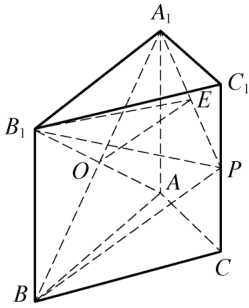
As seen in Fig. 7.2, we have PC=PC1PC = PC_1, PA1=PBPA_1 = PB. Suppose A1BA_1B and AB1AB_1 intersect at OO. Then we get OA1=OBOA_1 = OB, OA=OB1OA = OB_1, A1BAB1A_1B \perp AB_1.
Since PA=PB1PA = PB_1, then POAB1PO \perp AB_1. Therefore AB1AB_1 \perp plane PA1BPA_1B.
On plane PA1BPA_1B through OO draw line OEA1POE \perp A_1P with foot point EE.
Figure 2
Fig. 7.2
Connecting B1EB_1E, B1EO\angle B_1EO is then the plane angle of the dihedral angle BA1PB1B-A_1P-B_1. Assuming AA1=2AA_1 = 2, it is easy to find that PB=PA1=5PB = PA_1 = \sqrt{5}, A1O=B1O=2A_1O = B_1O = \sqrt{2}, PO=3PO = \sqrt{3}.
In right triangle PA1O\triangle PA_1O, we have A1OPO=A1POEA_1O \cdot PO = A_1P \cdot OE,
or 23=5OE\sqrt{2} \cdot \sqrt{3} = \sqrt{5} \cdot OE. So OE=65OE = \frac{\sqrt{6}}{\sqrt{5}}.
As B1O=2B_1O = \sqrt{2}, we have
B1E=B1O2+OE2=2+65=455. B_1E = \sqrt{B_1O^2 + OE^2} = \sqrt{2 + \frac{6}{5}} = \frac{4\sqrt{5}}{5}.
Finally,
sinα=sinB1EO=B1OB1E=2455=104. \sin \alpha = \sin \angle B_1EO = \frac{B_1O}{B_1E} = \frac{\sqrt{2}}{\frac{4\sqrt{5}}{5}} = \frac{\sqrt{10}}{4}. \quad \square

Want a route through all this instead of an archive? The track puts 2,000 problems in a working order, from AMC 10 level to the IMO shortlist.

Source: MathNet, licensed CC-BY-4.0. Statement and solution reproduced as published; topic and difficulty added by this site.