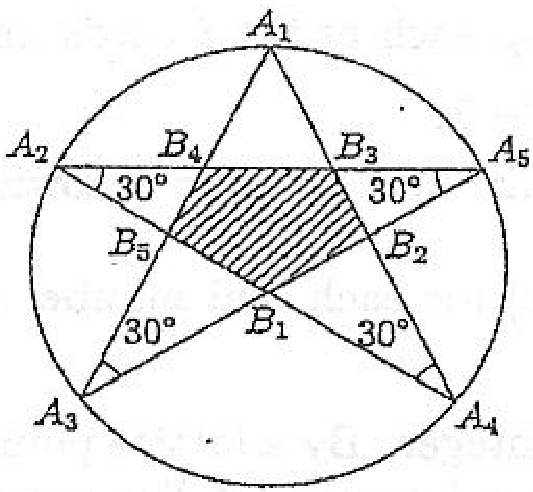
On the circumference of the circle with radius 1, points A1, A2, A3, A4, A5 are placed in this order, and they satisfy ∠A5A2A4=∠A1A3A5=∠A2A4A1=∠A3A5A2=30∘. Let B1, B2, B3, B4, B5 be the points of intersections of A2A4 and A3A5, A3A5 and A4A1, A4A1 and A5A2, A5A2 and A1A3, A1A3 and A2A4, respectively. Find the area of the pentagon B1B2B3B4B5.
Solution
63
First note that we have ∠A2A3A4=∠A2A3A1+∠A1A3A5+∠A5A3A4. By the theorem on subtended angles by arcs on the circumference on a circle, we have ∠A2A3A1=∠A2A4A1=30∘, ∠A5A3A4=∠A5A2A4=30∘. We also have ∠A1A3A5=30∘, and therefore, we conclude that ∠A2A3A4=90∘, which implies that the line segment A2A4 is a diameter of the given circle. Similarly, we get that the line segment A3A5 is also a diameter of the given circle, and therefore, the point B1 of the intersection of A2A4 and A3A5 is the center of the circle.
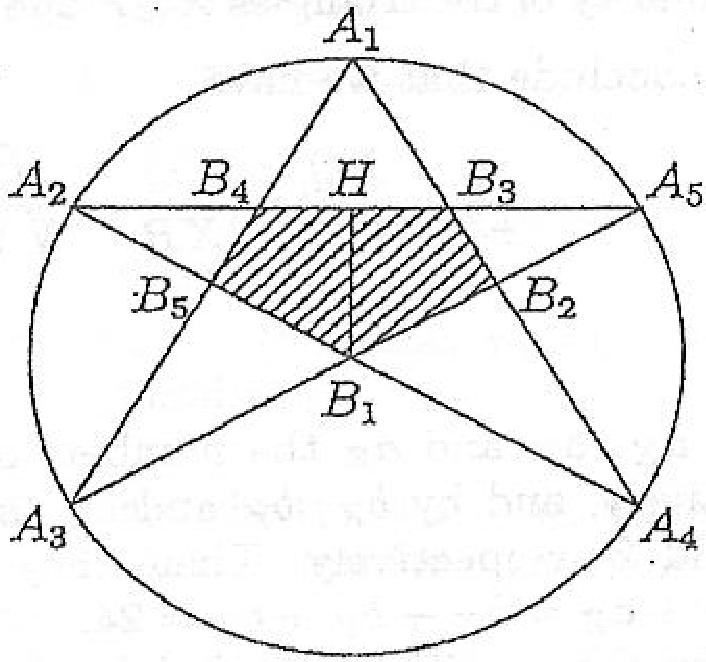
Let us denote by H the foot of the perpendicular line drawn from B1 to the line A2A5. For the triangle A2B1H, we have ∠HA2B1=30∘ and ∠B1HA2=90∘, from which we get ∠A2B1H=60∘. Using the fact that A2B1=1, we get B1H=21 and HA2=23, and then we obtain that the area of the triangle A2B1H=21⋅21⋅23=83.
For the triangle A3B1B5, we have ∠B5A3B1=30∘ and ∠A3B1B5=∠B1A5A2+∠B1A2A5=30∘+30∘=60∘, from which it follows that ∠B1B5A3=90∘. We therefore, conclude that B1B5=21 and B5A2=B1A2−B1B5=1−21=21.
For the triangle A2B4B5, we have ∠B5A2B4=30∘, ∠B4B5A2=∠B1B5A3=90∘, from which we get B4B5=B5A2tan30∘=21⋅33=63. Therefore, we conclude that the area of the triangle A2B4B5 equals 21⋅63⋅21=243.
Summarizing what we obtained so far, we now get that the area of the quadrilateral B1HB4B5 equals 83−243=123. Since we get in the same way that the area of the quadrilateral B1HB3B2 also equals 123, we conclude that the area of the pentagon B1B2B3B4B5 equals 2⋅123=63.
Want a route through all this instead of an archive? The track
puts 2,604 problems in a working order, from Junior Challenge level to the IMO shortlist.
Source: MathNet,
licensed CC-BY-4.0.
Statement reproduced verbatim; metadata (topic, difficulty) added by this project.