Because LM is parallel to BC, the problem is equivalent to proving that ∠AA1L=∠AML=∠ACB. We present two solutions:
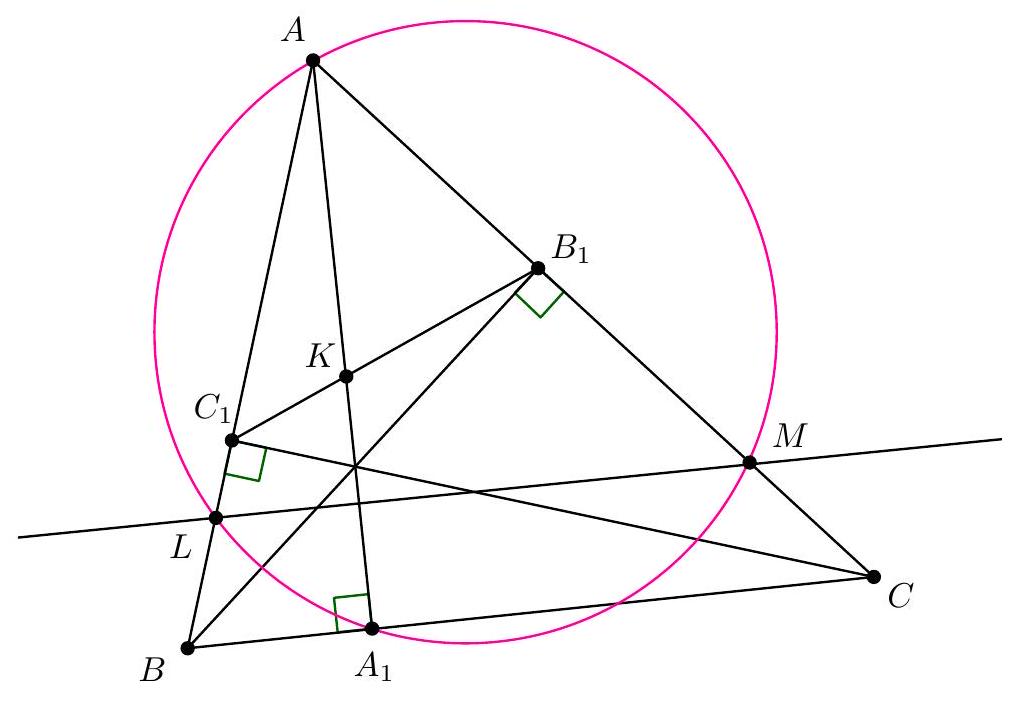
First solution. Let L1 be the point on AB such that ∠AA1L1=∠ACB and let us prove that L1=L.
Quadrilateral BCB1C1 is cyclic since ∠BC1C=∠BB1C=90∘. Therefore, ∠B1C1A=∠ACB=∠AA1L1. We deduce that the quadrilateral A1KC1L1 is cyclic. Hence, ∠L1KA1=∠L1C1A1.
Quadrilateral AC1A1C is cyclic since ∠CA1A=∠CC1A=90∘. We deduce that ∠L1C1A1=∠ACB. Thus, ∠L1KA1=∠AA1L1. This proves that L1A1=L1K, that is L1=L, the intersection point of the perpendicular bisector of KA1 with AB.
Second solution. Since LK=LA1, the problem is equivalent to proving that ∠LKA1=∠ACB. But ∠BHA1=90∘−∠A1BH=∠ACB, where H is the orthocenter of triangle ABC. Therefore, the problem is equivalent to proving that LK and BH are parallel.
We know that LBAL=NA1AN, where N is the midpoint of KA1, since LM and BC are parallel. It remains to prove that KHAK=NA1AN.
To simplify the notations let us write α=∠BAC, β=∠CBA and γ=∠ACB.
We know that ∠KC1A=γ, ∠HC1K=90∘−γ, ∠C1AK=90∘−β and ∠KHC1=β. We deduce by applying sine laws on triangles AC1K and C1HK that
KHAK=sin∠HC1K⋅sin∠C1AKsin∠KC1A⋅sin∠KHC1=tanβ⋅tanγ
On the other hand, we have NA1AN=NA1AK+1=2KA1AK+1. We also know that ∠A1C1K=180∘−2γ and ∠KA1C1=90∘−α. We deduce by applying sine laws on triangles AC1K and C1A1K that
KA1AK=sin2γ⋅cosβsinγ⋅cosα=2cosβ⋅cosγcosα
We deduce that
NA1AN=cosβ⋅cosγcosα+1=cosβ⋅cosγcosβ⋅cosγ−cos(β+γ)=tanβ⋅tanγ=KHAK.