In triangle , let be the centre of the excircle tangent to side at and to the extensions of sides and at and , respectively. Suppose that the lines and are perpendicular and intersect at . Let be the foot of the perpendicular from to line . Determine the angles and .
(Greece)
IMO Shortlist, 2006
Solutions — 3
Solution 1
Let be the intersection point of lines and . Obviously and since , the lines and are parallel and equal. From the right triangle we obtain from which we infer that and the right triangles and are similar. Hence , which implies that the lines and are perpendicular, i.e the points are collinear.
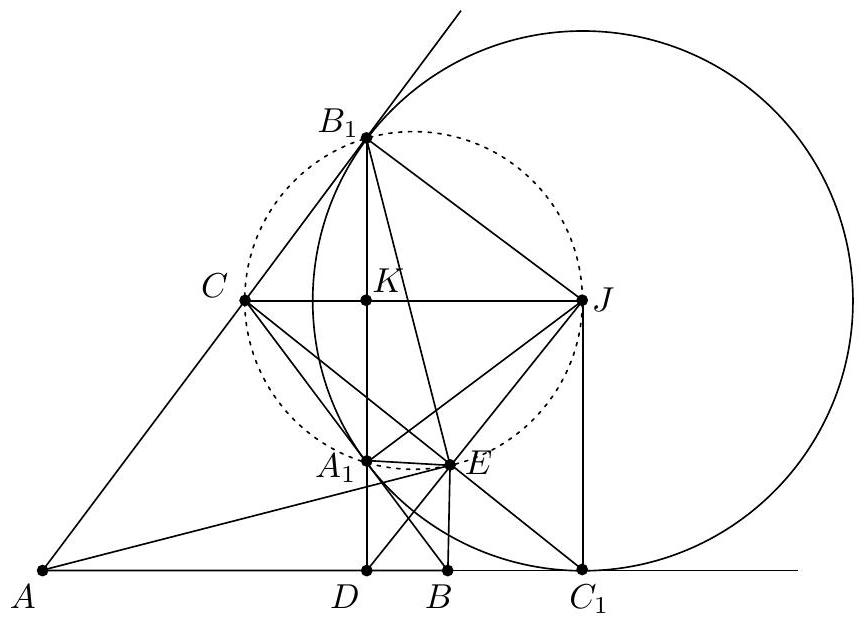
Since , points and lie on the circle of diameter . Then , which implies that quadrilateral is cyclic; therefore .
Quadrilateral is also cyclic because , therefore we obtain .
Solution 2
Consider the circles and of diameters and , respectively. Line segments and are tangents to those circles and, due to the right angle at , and pass through point . Since is a right angle, point lies on circle , therefore
Since are all radii of the excircle, we also have
These equalities show that lies on circles and as well, so .
Solution 3
First note that is perpendicular to the external angle bisector of and parallel to the internal angle bisector of that angle. Therefore, is perpendicular to if and only if triangle is isosceles, . In that case the external bisector is parallel to .
Triangles and are similar, as their corresponding sides are perpendicular. In particular, we have ; moreover, from cyclic deltoid ,
Therefore, bisects angle .
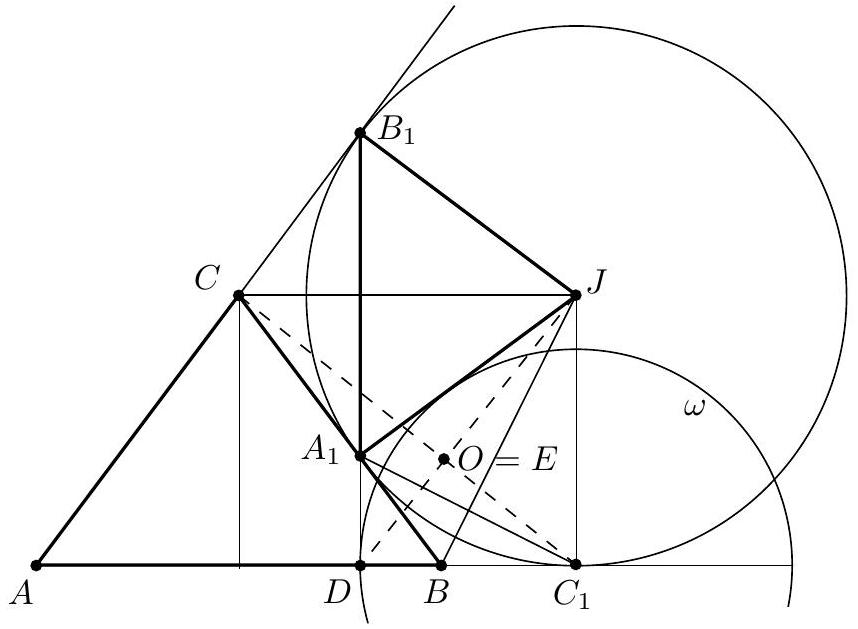
In triangle , line is the external bisector at vertex . The point is the intersection of two external angle bisectors (at and ) so is the centre of the excircle , tangent to side , and to the extension of at point .
Now consider the similarity transform which moves to to and to . This similarity can be decomposed into a rotation by around a certain point and a homothety from the same centre. This similarity moves point (the centre of excircle ) to and moves (the point of tangency) to .
Since the rotation angle is , we have for an arbitrary point . For and we obtain . Therefore lies on line segment and is perpendicular to . This means that .
For and we obtain , i.e.
Want a route through all this instead of an archive? The track
puts 2,604 problems in a working order, from Junior Challenge level to the IMO shortlist.