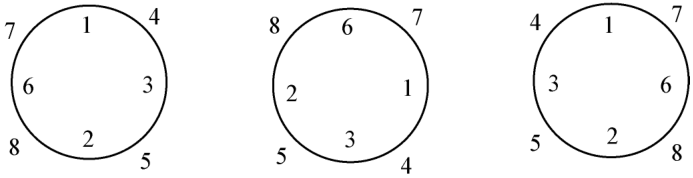
Denote the sum of labels of A and B by x and y, respectively. Then y=2x. Thus, we have
3x=x+y=1+2+⋯+12=78,x=26.
Obviously, 1,2∈A and 11,12∈B. Denote A={1,2,a,b,c,d}, where a<b<c<d. Then a+b+c+d=23, and a≥3, 8≤d≤10 (if d≤7, then a+b+c+d≤4+5+6+7=22, which is a contradiction.)
(1) If d=8, then A={1,2,a,b,c,8}, c≤7, a+b+c=15. Thus, (a,b,c)=(3,5,7) or (4,5,6), that is, A={1,2,3,5,7,8} or A={1,2,4,5,6,8}.
If A={1,2,3,5,7,8}, then B={4,6,9,10,11,12}. Since B contains 11,4,6 and 12, there is only one tower that, in A, 8 and 3, 3 and 1, 1 and 5, 5 and 7 are adjacent.
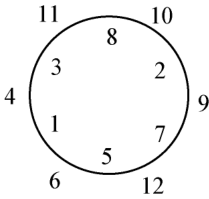
If A={1,2,4,5,6,8}, then B={3,7,9,10,11,12}. Similarly, we see that, in A, 1 and 2, 5 and 6, 4 and 8 are adjacent, respectively. There are two arrangements, that is, there are two towers.
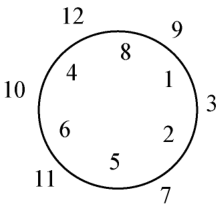
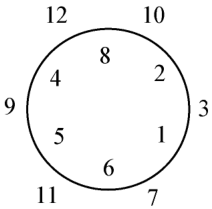
(2) If d=9, then A={1,2,a,b,c,9}, c≤8, a+b+c=14, where (a,b,c)=(3,5,6) or (3,4,7), that is, A={1,2,3,5,6,9} or A={1,2,3,4,7,9}.
If A={1,2,3,5,6,9}, then B={4,7,8,10,11,12}. To obtain 4, 10 and 12 in B, 1, 3, and 9 in A must be adjacent pairwise, it is impossible!
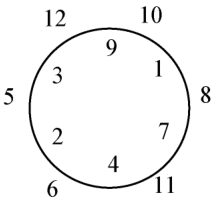
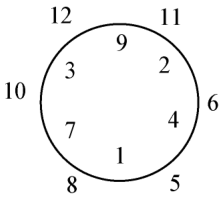
If A={1,2,3,4,7,9}, then B={5,6,8,10,11,12}. To obtain 6, 8 and 12 in B, 2 and 4, 1 and 7, 9 and 3 must be adjacent in A, respectively. There are two arrangements, that is, there are two towers.
(3) If d=10, then A={1,2,a,b,c,10}, where c≤9, a+b+c=13. Thus, (a,b,c)=(3,4,6), that is, A={1,2,3,4,6,10} and B={5,7,8,9,11,12}. To obtain 8, 9, 11 and 12 in B, 6 and 2, 6 and 3, 10 and 1, 10 and 2 must be adjacent, respectively. There is only one tower.
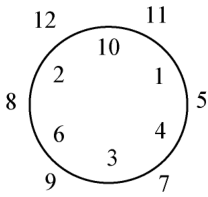
Summing up, there are six different towers all together. ☐