Let be a circle with diameter and a point on it different than and such that . On the radius we consider the point and the circle () with center and radius . We draw the tangents and from to the circle (). Prove that the straight lines , and are concurrent.
BMO Shortlist, 2010
Solution
Let the lines and meet at point . We will prove that the line passes through (see figure 1).
The circle is homothetic to the circle with respect to homothety with center and ratio , say . The extension of meets the circle () at a point homothetic of . The extension of meets the circle () at a point homothetic of .
Therefore the line segment is homothetic of the line segment . So, if the line intersects at the point , then will be homothetic of . Since is homothetic of , we conclude that
We will prove that
Since and are tangents from to the circle (), then is the perpendicular bisector of the segment . Let be the intersection point of the lines and , such that the extension of intersects at and the circle () at point . Then will be the middle point of the segment (because of the homothety).
We assert that is the symmedian of the triangle which corresponds to the vertex . According to Steiner's theorem to symmedians, it is enough to prove that
For proving the relation (3) we use the areas ratio:
Since the angles and are the angles between tangents and chord we have
and therefore
From (4) we obtain
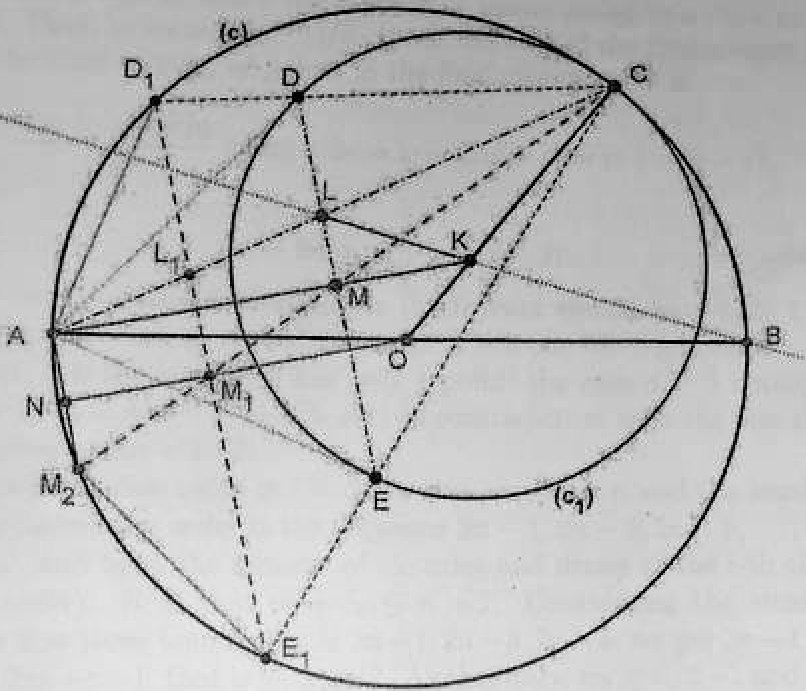
Figure 1
So, the relation (3) is proved and is the symmedian of the triangle which corresponds to the vertex .
Hence and the quadrilateral is an isosceles trapezium. The line is perpendicular to and intersects at the middle . In the triangle we have that is the middle of the side and . Hence is the middle of and therefore is the mid-parallel of and . Since belongs to , it will be the middle of . In the triangle is the mid-parallel to . Hence and the straight lines , and are concurrent.
Want a route through all this instead of an archive? The track
puts 2,604 problems in a working order, from Junior Challenge level to the IMO shortlist.