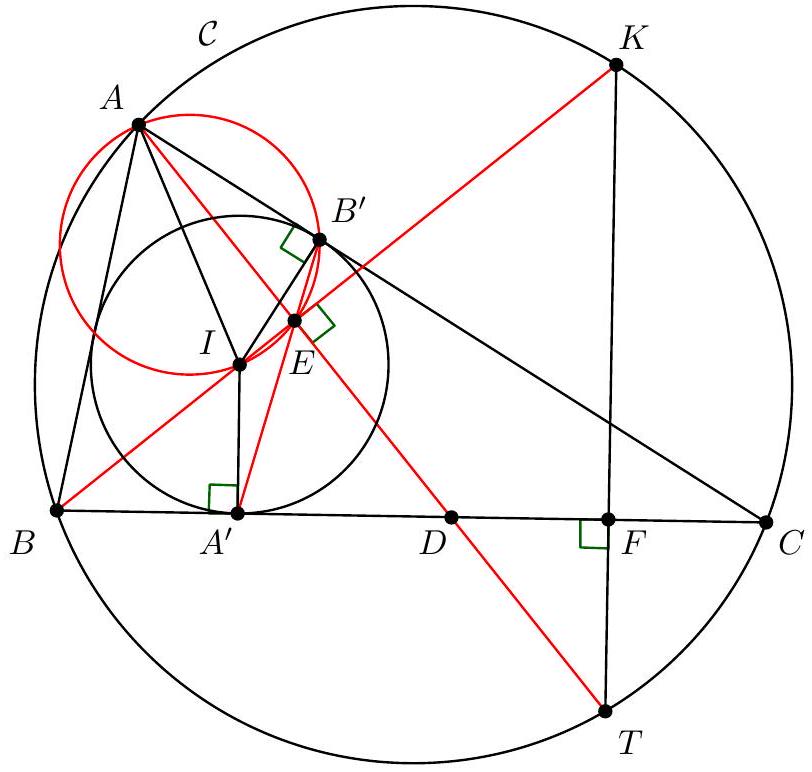
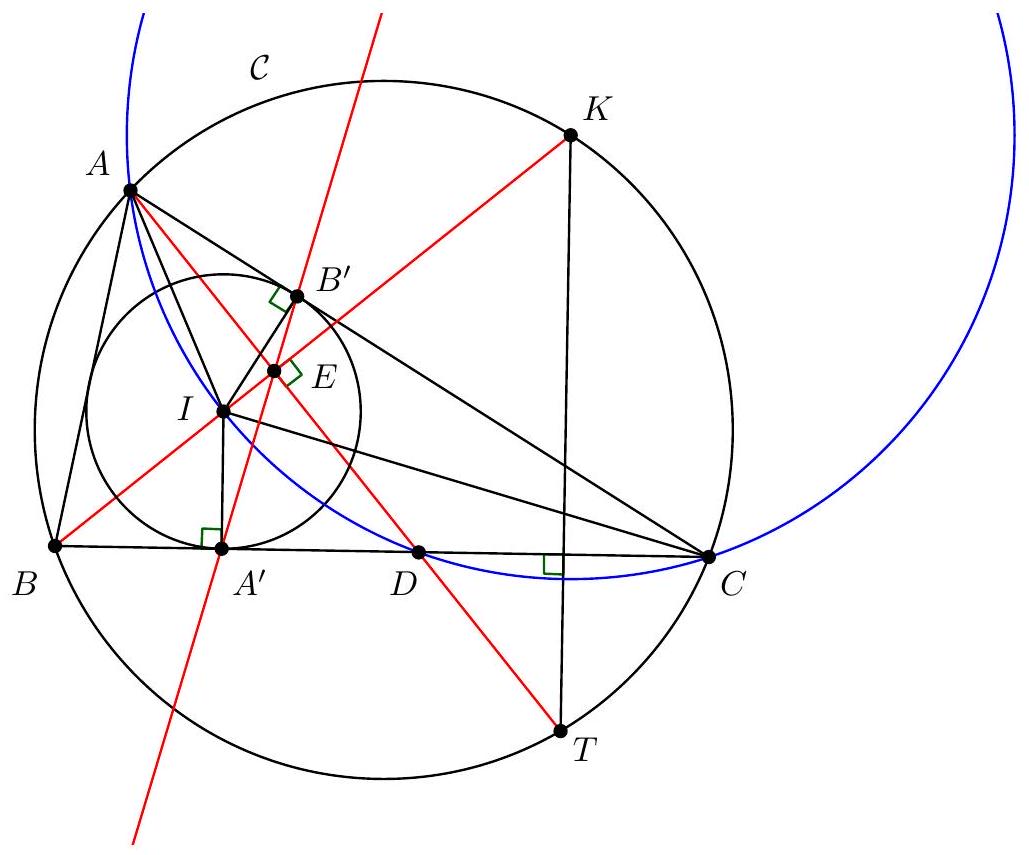
△ABC is a triangle with AB<BC, C its circumcircle, K the midpoint of the minor arc \overparenCA of the circle C and T a point on C such that KT is perpendicular to BC. If A′, B′ are the intouch points of the incircle of △ABC with the sides BC, AC, prove that the lines AT, BK, A′B′ are concurrent.
Solution
Let E be the intersection point of BK with AT. The problem is equivalent to prove that points A′, E, B′ are collinear.
First solution. Let F be the intersection point of BC with KT. Since K is the midpoint of CA, by expressing the angles in terms of arc lengths we obtain ∡KEA=21(\overparenKA+\overparenBT)=21(\overparenCK+\overparenBT)=∡CFK=90∘ But B′ is an intouch point. This implies that ∡AB′I=90∘=∡AEI, and the points A, I, E, B′ are concyclic.
We deduce from this that ∡IB′E=∡IAE=90∘−∡EIA=90∘−21∡BAC−21∡CBA=21∡ACB. On the other hand, triangle IA′B′ is isosceles (IA′=IB′). Therefore, ∡IB′A′=21(180∘−∡A′IB′)=21∡ACB=∡IB′E, since ∡CA′I=90∘. This proves that the points A′, E, B′ are collinear.
Second solution. We prove as in the first solution that ∡KEA=90∘. Let D be the intersection point of AT with BC. The pedal triangle of I with respect to triangle ADC is A′B′E. Proving that points A′, B′, E are collinear is equivalent to proving that I is on the circumcircle of triangle ADC and therefore, the line A′B′E will be the Simson line of point I with respect to triangle ADC.
We have ∡CDA=∡DBA+∡BAD=∡CBA+90∘−21∡CBA=90∘+21∡CBA. On the other hand ∡CIA=180∘−21∡BAC−21∡ACB=90∘+21∡CBA=∡CDA. This proves that I is on the circumcircle of triangle ADC and thus A′, E, B′ are collinear.
Want a route through all this instead of an archive? The track
puts 2,000 problems in a working order, from AMC 10 level to the IMO shortlist.
Source: MathNet,
licensed CC-BY-4.0.
Statement and solution reproduced as published; topic and difficulty added by this site.