Maths Olympiad Prep

Library / /30 of 53

Geometry Difficulty 6.3 National olympiad Prove it China

In triangle ABCABC, AB=ACAB = AC. Point DD is the midpoint of side BCBC. Point EE lies outside the triangle ABCABC such that CEABCE \perp AB and BE=BDBE = BD. Let MM be the midpoint of segment BEBE. Point FF lies on the minor arc AD^\widehat{AD} of the circumcircle of triangle ABDABD such that MFBEMF \perp BE. Prove that EDFDED \perp FD.

Solution

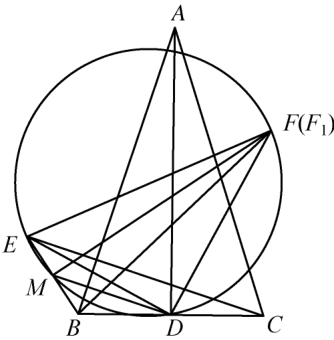
Solution 1. Construct point F1F_1 such that EF1=BF1EF_1 = BF_1 and ray DF1DF_1 is perpendicular to line EDED. It suffices to show that F=F1F = F_1 or ABDF1ABDF_1 is cyclic; that is,
BAD=BF1D.1 \angle BAD = \angle BF_1 D. \qquad \textcircled{1}
Set BAD=CAD=x\angle BAD = \angle CAD = x. Because ECABEC \perp AB and ADBCAD \perp BC,
ECB=90ABD=BAD=x. \angle ECB = 90^\circ - \angle ABD = \angle BAD = x.
Note that MDMD is a midline of triangle BCEBCE. In particular, MDECMD \parallel EC and
MDB=ECD=x.2 \angle MDB = \angle ECD = x. \qquad \textcircled{2}
In isosceles triangle EF1MEF_1M, we may set EF1M=BF1M=y\angle EF_1M = \angle BF_1M = y. Because EMMF1EM \perp MF_1 and MDDF1MD \perp DF_1,
EMF1=EDF1=90, \angle EMF_1 = \angle EDF_1 = 90^\circ,
implying that EMDF1EMDF_1 is cyclic. Consequently, we have
EDM=EF1M=y.3 \angle EDM = \angle EF_1 M = y. \qquad \textcircled{3}
Combining ② and ③, we obtain
Figure 1
Fig. 2. 2
BDE=EDM+MDB=x+y. \angle BDE = \angle EDM + \angle MDB = x + y.
Because BE=BDBE = BD, we conclude that triangle BEDBED is isosceles with MED=BED=BDE=x+y\angle MED = \angle BED = \angle BDE = x + y. Because EMDF1EMDF_1 is cyclic, we have MF1D=MED=x+y\angle MF_1 D = \angle MED = x + y. It is then clear that
BF1D=MF1DMF1B=x=BAD, \angle BF_1 D = \angle MF_1 D - \angle MF_1 B = x = \angle BAD,
which is ①.

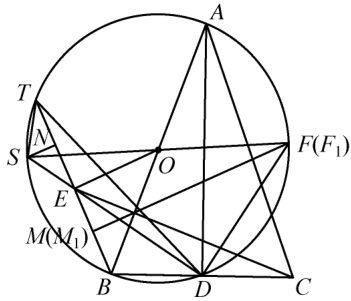
Solution 2. (Based on work by Sherry Gong and Inna Zakharevich) We maintain the notations used in Solution 1. Let ω\omega and OO denote the circumcircle and the circumcenter of triangle ABDABD, and let TT be second intersection (other than BB) between line BEBE and ω\omega. Extend segment DEDE through EE to meet ω\omega at SS. Point F2F_2 lies on ω\omega such that DF2DEDF_2 \perp DE. We will show that F2=FF_2 = F or F2B=F2EF_2B = F_2E. Let M2M_2 denote the foot of the perpendicular from F2F_2 to line BEBE. It suffices to show that M2M_2 is the midpoint of segment BEBE, that is, EM2=M2BEM_2 = M_2B.
Because SDF2=EDF2=90\angle SDF_2 = \angle EDF_2 = 90^\circ, OO is the midpoint of SF2SF_2. Because BTADBTAD is cyclic, BTD=BAD=BCE=x\angle BTD = \angle BAD = \angle BCE = x. Note also that BD=BEBD = BE and EBC=DBT\angle EBC = \angle DBT. We conclude that triangle BDTBDT and BECBEC are congruent to each other, implying that BE=ETBE = ET. Hence, OEBTOE \perp BT. Let NN be the foot of the perpendicular from SS to line BEBE.
Figure 2
Fig. 2. 3
Note that segments NENE and EM2EM_2 are the respective perpendicular projections of segments SOSO and OF2OF_2 onto line BEBE. Because SO=OF2SO = OF_2, NE=EM2NE = EM_2. Because TE=EBTE = EB, it suffices to show that TN=NETN = NE, which is evident since
STE=SEB=SDB=EDB=BED=SET \angle STE = \angle SEB = \angle SDB = \angle EDB = \angle BED = \angle SET
and so triangle SETSET is isosceles with SE=STSE = ST.

Want a route through all this instead of an archive? The track puts 2,000 problems in a working order, from AMC 10 level to the IMO shortlist.

Source: MathNet, licensed CC-BY-4.0. Statement and solution reproduced as published; topic and difficulty added by this site.