Olympiad Maths Prep

Library / /5 of 5

Geometry Difficulty 6.5 National olympiad Prove it Greece

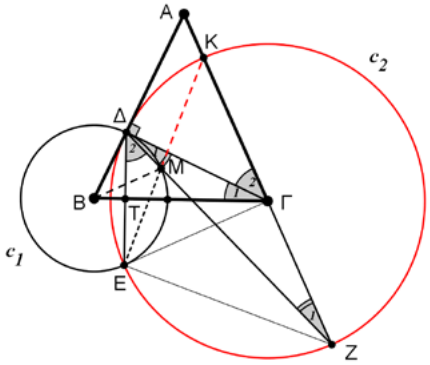
Let ABΓA B \Gamma be an isosceles acute angled triangle with AB=AΓAB = A\Gamma. Let ΓΔ\Gamma\Delta be an altitude of the triangle. The circle c2(Γ,ΓΔ)c_2(\Gamma, \Gamma\Delta) intersects AΓA\Gamma at point KK, the extension of AΓA\Gamma at point ZZ and the circle c1(B,BΔ)c_1(B, B\Delta) at point EE. Finally, ΔZ\Delta Z intersects the circle c1c_1 at point MM. Prove that

a. ZΔ^E=45Z\hat{\Delta}E = 45^\circ

b. The points EE, MM, and KK are collinear.

c. The line BMBM is parallel to the line EΓE\Gamma.

Solution

a.
From the right angled triangle BΓΔB\Gamma\Delta we have: Γ^1=90B^\hat{\Gamma}_1 = 90^\circ - \hat{B}.
The line joining the centers of the circles c1c_1 and c2c_2 is the perpendicular bisector of their common chord ΔE\Delta E.
If TT is the point of intersection of the lines BΓB\Gamma and ΔE\Delta E, then:
Γ^1+Δ^1+Δ^2=90, that is Δ^1+Δ^2=B^=Γ^.(1) \hat{\Gamma}_1 + \hat{\Delta}_1 + \hat{\Delta}_2 = 90^\circ, \text{ that is } \hat{\Delta}_1 + \hat{\Delta}_2 = \hat{B} = \hat{\Gamma}. \quad (1)
From the isosceles triangle ΓΔZ\Gamma\Delta Z we have: Δ^1=Z^1\hat{\Delta}_1 = \hat{Z}_1 and Γ^2=2Δ^1=90A^\hat{\Gamma}_2 = 2\hat{\Delta}_1 = 90^\circ - \hat{A}, and hence:
Δ^1=45A^2.(2) \hat{\Delta}_1 = 45^\circ - \frac{\hat{A}}{2}. \quad (2)
From the isosceles triangle ABΓAB\Gamma we have: B^=90A^2\hat{B} = 90^\circ - \frac{\hat{A}}{2} \quad (3)
From (1), (2), (3) we get:
Δ^1+Δ^2=B^=Γ^Δ^2=B^Δ^1(2),(3)Δ^2=90A^2(45A^2)=45. \hat{\Delta}_1 + \hat{\Delta}_2 = \hat{B} = \hat{\Gamma} \Leftrightarrow \hat{\Delta}_2 = \hat{B} - \hat{\Delta}_1 \stackrel{(2),(3)}{\Leftrightarrow} \hat{\Delta}_2 = 90^\circ - \frac{\hat{A}}{2} - \left( 45^\circ - \frac{\hat{A}}{2} \right) = 45^\circ.

b.
The angle Δ^1\hat{\Delta}_1 is created from the chord ΔM\Delta M and the tangent ΔΓ\Delta\Gamma of the circle c1c_1, and hence ΔE^M=Δ^1\Delta\hat{E}M = \hat{\Delta}_1. Also we have ΔE^K=ΔZ^K=Z^1\Delta\hat{E}K = \Delta\hat{Z}K = \hat{Z}_1.
Since Δ^1=Z^1\hat{\Delta}_1 = \hat{Z}_1, we get ΔE^M=ΔE^K\Delta\hat{E}M = \Delta\hat{E}K, and the points EE, MM, KK are collinear.

c.
We will prove that ΔB^M=90A^\Delta\hat{B}M = 90^\circ - \hat{A}.
We have ΔB^M=2ΔE^M=2Λ^1=Γ^2=90A^\Delta\hat{B}M = 2\Delta\hat{E}M = 2\hat{\Lambda}_1 = \hat{\Gamma}_2 = 90^\circ - \hat{A}, and hence BMAΓBM \perp A\Gamma. Moreover EK^Z=EΔ^Z=Λ^2=45E\hat{K}Z = E\hat{\Delta}Z = \hat{\Lambda}_2 = 45^\circ, and so the orthogonal triangle EZKEZK isosceles. Then its median EΓE\Gamma is also an altitude, that is EΓKZE\Gamma \perp KZ. Hence BMEΓBM \parallel E\Gamma (both are perpendicular to the line AZAZ).

Figure 1
Figure 2

Looking for a route rather than an archive? The track puts 2,000 problems in a working order, from AMC 10 level to the IMO shortlist.

Source: MathNet, licensed CC-BY-4.0. Statement and solution reproduced as published; topic and difficulty added by this site.