A beetle is creeping on the coordinate plane, starting from point (0;−1), along a straight line until reaching the x-axis at point (−x;0) where x is a positive real number. After that it turns 90∘ to the right and creeps again along a straight line until reaching the y-axis. Then it again turns right by 90∘ and creeps along a straight line until reaching the x-axis, where it once more turns right by 90∘ and creeps along a straight line until reaching the y-axis.
a) Can it happen that both the length of the beetle's journey and the distance between its initial and final point are rational numbers?
b) Can it happen that both the length of the beetle's journey and the distance between its initial and final point are integers?
Solution
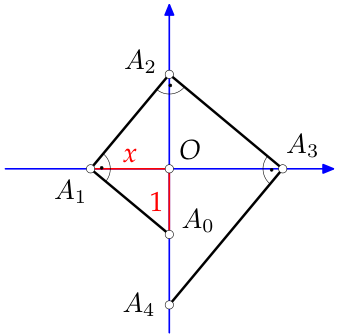
Let O be the origin of coordinates. Let A0 be the starting point of the beetle's journey, A1 the first turning point, A2 the second turning point, A3 the third turning point and A4 the endpoint (see figure below).
The right triangles OA0A1 and OA1A2 are similar with ratio x because ∠OA1A2=90∘−∠OA1A0=∠OA0A1 and OA0OA1=x. So are the triangles OA1A2 and OA2A3 similar with ratio x since OA1OA2=x by similarity of the triangles OA0A1 and OA1A2. Analogously, the triangles OA2A3 and OA3A4 are similar with ratio x. Consequently, OA2=x2, OA3=x3 and OA4=x4.
By the Pythagorean theorem, the length of the beetle's journey is 1+x2+x2+x4+x4+x6+x6+x8, or equivalently, (1+x+x2+x3)1+x2 which equals (x4−1)⋅x−1x2+1 if x=1. On the other hand, the distance between A0 and A4 is ∣x4−1∣.
a) Taking x=34, the number x4−1 is rational, since x is rational. As 1+x2=1+916=35, the number (x4−1)⋅x−1x2+1 is also rational.
b) Assume that the distance between A0 and A4 is an integer; then x4 is an integer. Suppose that (x4−1)⋅x−1x2+1, the length of the beetle's journey, is also an integer (one can assume x=1 since otherwise the length of the journey is 42 that is not an integer). As x4−1 is an integer, the number x−1x2+1 must be rational. Consider three cases.
1) If x is an integer then x−1 is integer whence x2+1 must be rational and x2+1 must be a perfect square. This is impossible as two consecutive positive integers cannot be perfect squares.
2) Suppose that x is irrational and x2 is an integer. As (x−1)2x2+1 is the square of a rational number, so is also x2+1(x−1)2. Hence x2+12x must be rational. But this is impossible, since 2x is irrational and x2+1 is an integer.
3) Let x2 be irrational. Similarly to the previous case we see that x2+12x is rational. Hence (x2+1)24x2 is the square of a rational number, implying that 4x2(x2+1)2 is rational. The latter in turn implies that 4x2x4+1 must be rational. This is impossible as 4x2 is irrational and x4+1 is a positive integer.
Want a route through all this instead of an archive? The track
puts 2,604 problems in a working order, from Junior Challenge level to the IMO shortlist.
Source: MathNet,
licensed CC-BY-4.0.
Statement reproduced verbatim; metadata (topic, difficulty) added by this project.