a) From the statement, ∠ABC=81∘ and, in the isosceles triangle ABD, ∠ADB=∠ABD=81∘, hence ∠DAB=18∘ and ∠CAD=∠CAB−∠DAB=36∘.
The isosceles triangle BED yields ∠BED=∠BDE=81∘, therefore ∠DBE=18∘, whence ∠ABF=∠ABC−∠EBD=63∘.
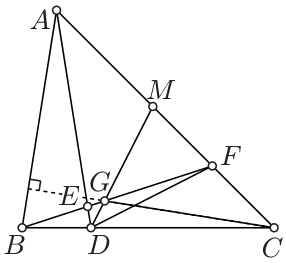
From the triangle ABF, ∠ABF=63∘ and ∠FAB=54∘, hence ∠AFB=63∘, that is triangle ABF is isosceles, with AF=AB.
b) The relations AD=AB and AF=AB lead to AF=AD, so the triangle AFD is isosceles, with ∠AFD=∠ADF=2180∘−∠FAD=72∘. Since DM is the bisector of the angle ADF, ∠ADM=∠FDM=2∠ADF=36∘. The triangle AMD gives ∠MAD=∠ADM=36∘, therefore ∠CMD=72∘.
From CG⊥AB follows ∠ACG=90∘−∠CAB=36∘, so the triangle CMG has ∠ACG=36∘ and ∠CMG=72∘. This gives ∠CGM=72∘, that is the triangle CMG is isosceles, with CG=CM.