A dodecahedron and a vertex of the dodecahedron are given. An ant started from , walked along the edges of the dodecahedron, passing each of the vertices of the dodecahedron except just once, and returned to . How many such routes exist? We consider a route and its reversal to be different.
Japanese Mathematical Olympiad - The First Round
Solution
Take an arbitrary route. For each face, count the number of the edges on the face which are on the route. Since they can be neither less than nor more than , and they add up to , there exists exactly faces with of their edge on the route.
Now, assume that the ant passed consecutive four edges of a face as below.
---
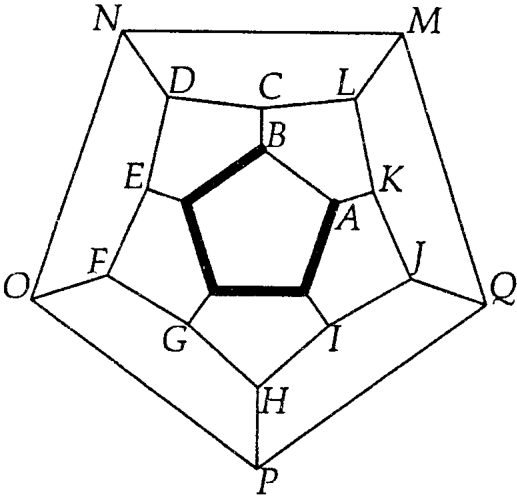
Since the ant did not pass edge , the ant passed the edges and . Also, since all the vertices must be passed just once, looking at vertices , and , it follows that the route contains edges , , , , and . By the same reason, looking at vertices and , it follows that it contains , and . There are two ways to complete the route: one is to take the edges , , , and ; the other is to take , , , and .
Now we can compute how many ways are there to make a route. There are ways to choose the first face, ways to choose the lacked edge, ways to complete the route, and ways to decide the direction. Since each route appears exactly times (note that there are faces of which edges are contained in a route), there are routes.
Want a route through all this instead of an archive? The track
puts 2,604 problems in a working order, from Junior Challenge level to the IMO shortlist.