Let be a square with sides of length and be a rhombus with sides of length and angles measuring and . These quadrilaterals are arranged to have the same centre and the diagonals of the rhombus are parallel to the sides of the square. Calculate the area of the region on which the figures overlap.
South African Mathematical Olympiad Third Round
Solution
Let be the square , with centre . Let be the rhombus , with the short diagonal, and the midpoint of . Since the diagonals of bisect the angles of , we have that , so that forces to have length . We may therefore assume that is the midpoint of and is the midpoint of . See Figure 1.
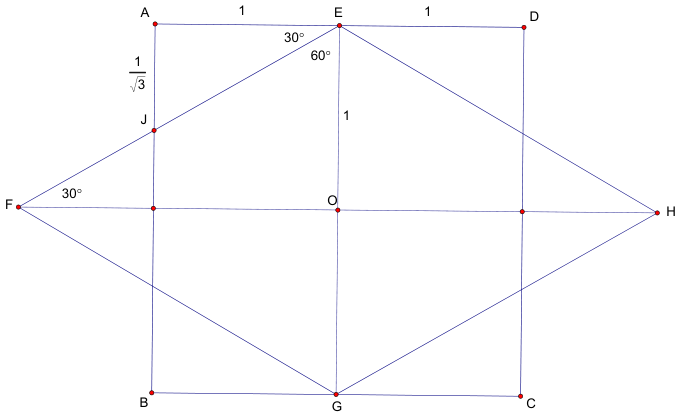
Figure 1
Consequently, so that implies that . The area of the region where and overlap is therefore, by symmetry, equal to the area of minus four times the area of triangle , i.e.,
Want a route through all this instead of an archive? The track
puts 2,604 problems in a working order, from Junior Challenge level to the IMO shortlist.